Capsule Hotel in Kuala Lumpur

The basic premise of a capsule hotel is, just how much space do you actually need for a one-night stay? Fundamentally, you just need to be able to lie down and then get up and leave once you have rested. The concept has been around for a while now, particularly in Asia. As a family, we have stayed in minimalist rooms where you are provided with a cubicle containing nothing but a large bunk bed, but I had yet to try the solo version.

I recently flew to Kuala Lumpur via Singapore, and decided to book-end my stay in Malaysia by trying out two different capsule hotels. Kuala Lumpur International has a couple at Terminal 2, one air-side and one land-side.

The automated gates recognised my Australian passport, letting me out into the Arrivals hall, and I followed my printed instructions to get to the CapsuleTransit Landside capsule hotel.

Or tried to. Arrivals is on Level 2, and the instructions were to take the lift to Level 1, but the lifts only went up, not down. Eventually I got there via the car parks, and after a bit of searching, found the entrance to the capsule hotel tucked away behind the car rental desks. Friendly staff retrieved my booking, handed me a bag containing towel, water, toothbrush, earplugs, eye mask, and gave me a key card. This allowed me to open a secure door that led into a warren of little metal containers, all stacked on top of one another, accessible via ladders and walkways. 
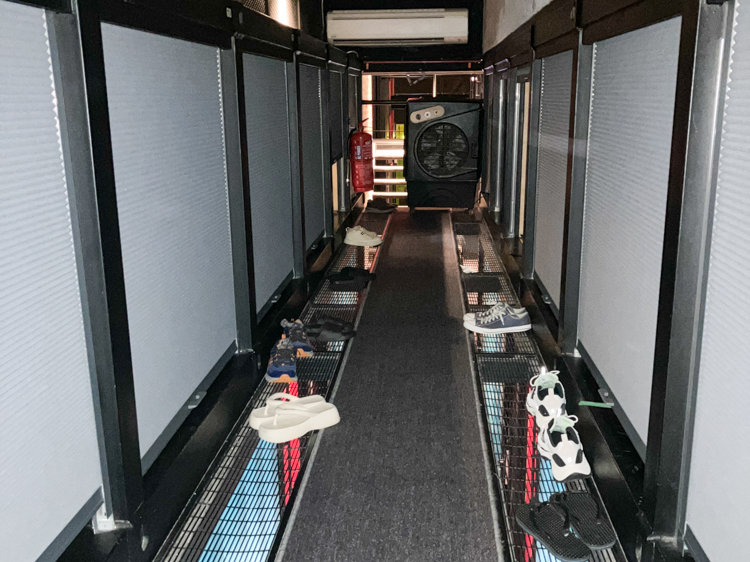
I found number 316 up a ladder and about half way down a walkway. Inside was a comfortable mattress, clean sheets, a small fold-down table, and a mirror.
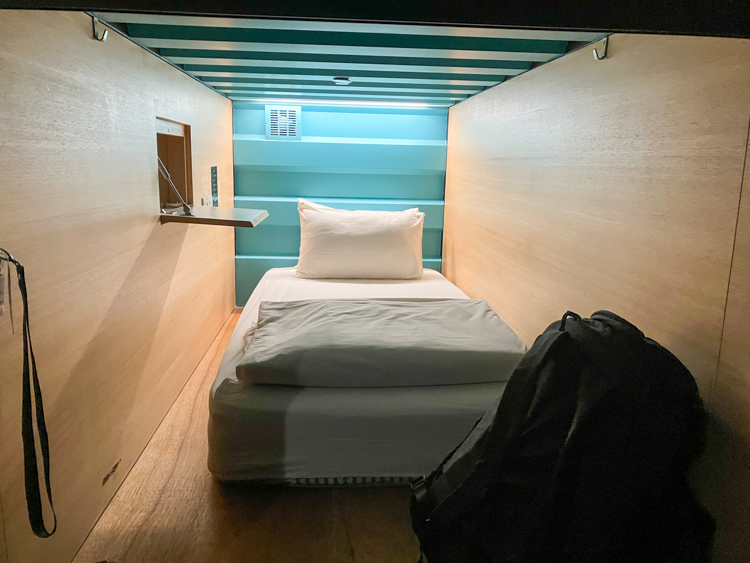
I slid the paper screen down behind me. There was enough room to get undressed, and to sit up in bed and read a book. It was remarkably quiet, considering there were other capsules all around. When I turned out the light, I quickly fell into a comfortable sleep. 
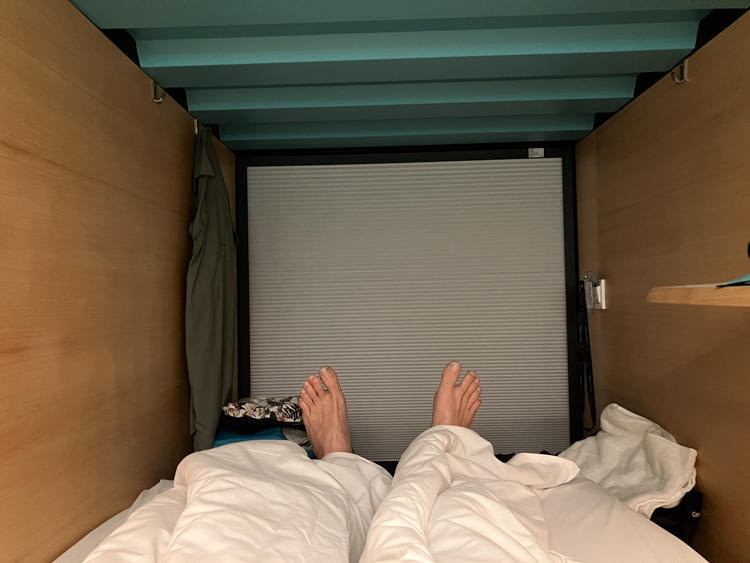
In the morning, I made my way in the provided slippers to the shared bathroom for a shower. The bathroom was clean and quiet, simple but with everything you needed. Refreshed, I dropped my key card at reception, and headed out into the city.

I concluded my business in Kuala Lumpur, and headed back to KLIA2. On this occasion, I had booked a room air-side at another CapsuleTransit capsule hotel, reasoning that it would be best to get a good night’s sleep inside the terminal, close to my departure gate.

Once at the Departure hall, I checked in for my flight using the airline’s app, but it wouldn’t give me a boarding pass to Singapore (not uncommon for an international flight). I tried one of the automated machines at check in, but it wouldn’t give me a boarding pass until 4 hours before departure. The checkin desks were all closed, with no sign that they were opening any time soon. 

I needed a boarding pass to get through security, and I needed to get through security because my hotel was air-side, at the departure gate. 

I got on the phone to the airline, Scoot, and explained my predicament. After checking my details, she talked me through logging in to their website portal where I was able to download my boarding pass as a PDF onto my phone. Thank you, Scoot

Even then, I had another hurdle. Security at immigration didn’t want to let me in because I was (to them, at least) a day early for my flight. I politely explained to the guard, and then to their boss, and then to their boss’s boss, and they waved me in.

The air-side hotel is near the food hall in the nexus between the P and Q arms of international gates, and was pretty easy to find. These capsule hotels can be booked for any period from one hour up, and although I had booked for a full twelve hours, I had quite a bit of time to kill before I checked in at 4pm. I ate some salad and drank some wine, and then returned to the hotel. 

The checkin process was the same as land-side, but the capsules were different. Far fewer in number, here at the departure gates, and of a different design. Taller, and slightly narrower due to the presence of shelving and a small safe. The difference in width didn’t seem much at first, but I banged my elbows a lot getting changed.
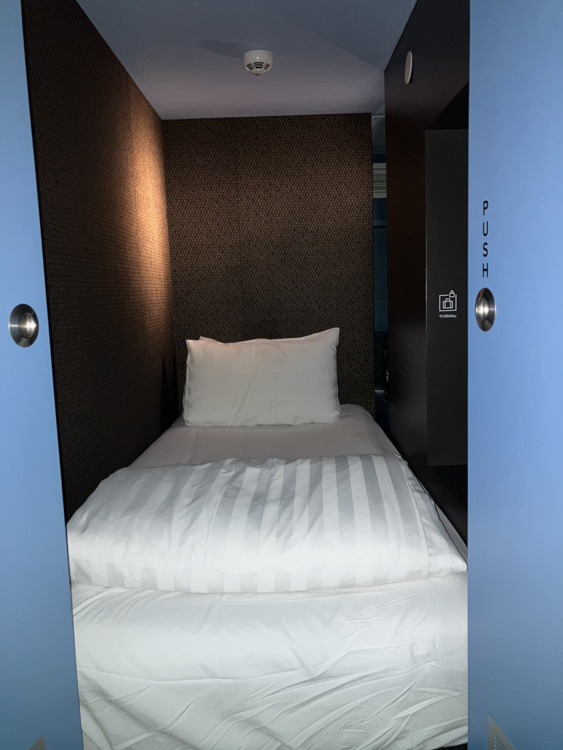
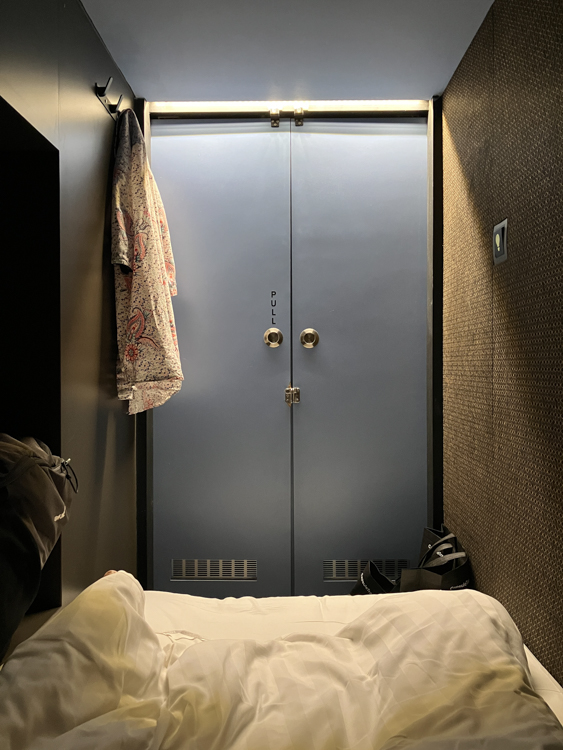
There was also a lot more noise from the infrastructure, there were rolling and grinding noises from some of the capsules above, and a snoring guy, and the mattress squeaked a bit. 

Still, I had no trouble sleeping till 3:30, then a nice hot shower in a large clean cubicle. I ate a salad that I had bought the previous night, just in case, but in fact the food court was already open. 

From the shower, straight to my gate. It could hardly be more convenient for a solo traveller, at A$100 for twelve hours. For a couple or a family, though, especially if you have any luggage, a similar price per person could easily get you a room in an airport hotel with all the usual facilities. For instance, at KLIA we often stay at Sama-Sama which costs about A$250 for a family room with access to pool, sauna, restaurants.

I like being pampered at Sama-Sama as much as the next person, but for a no-fuss, no-frills solo option, and travelling without any luggage, the capsule hotel works for me.

A Health Check in Malaysia

As a reasonably fit gentleman of a certain age, I am starting to see equally fit friends and colleagues suddenly getting unexpectedly sick and sometimes dying. Having only recently been surprised by a gangrenous appendix, I had been looking for somewhere that could give me a full-body health check to see what else might be going wrong inside. The somewhat overloaded medical system in Tasmania is really only geared toward curing sick people, rather than to preventative medicine. I can go to my doctor to get a scan for this or that, but only if referred because of a particular ailment.

I knew that the ‘health screening’ clinics for well people are ubiquitous in South East Asia, and that they are often happy to accept foreigners, medical tourists if you will. I researched a number of places in Thailand and Vietnam, before finally settling on Gleneagles Hospital in Kuala Lumpur. It has a good reputation in the ex-pat community, and also has the advantage of being situated in Malaysia, a country that I enjoy visiting very much.

Into Kuala Lumpur

Checking out of my capsule hotel at Kuala Lumpur International Airport, I boarded the Ekspress to Sentral. I’ve taken this train often, and it is always efficient, clean, and pleasant. The first part of the journey is through endless palm plantations rooted in floodplain (the wet ground always makes me wonder how the palms are harvested).

On this occasion, I noticed a lot of cleared land with new row housing going up, and then there was a blur of completed apartment blocks, and we arrived. 

I had a great nasi lemak at a cafe at the train station. Everybody in KL seems to be on their phones the whole time, and this cafe was set up for it. You could go in and sit down, and the waiter brought a menu, but all ordering was through a QR code on a paper receipt standing ready at the table. 

As I finished my black tea, I could hear a lot of cheering and chanting in the main station hall. I went to find out what was going on, and found a large number of women doing Pound Rockstar, vigorous exercise with sticks and music, with lots of shouting. They were having a great time. 

I’d decided to walk across town to the suburb of Ampang, partly because why not, but also because I couldn’t check into my rented apartment there until the afternoon. 

I set off, following the river Klang which is perhaps ironically (I hope so) signposted as the ‘River of Life’. It is pretty much a concrete open sewer, hung about with storm-torn fragments of plastic and fabric, with a certain aromatic miasma, graffiti, and under-bridge tent villages.

After amusing myself examining infrastructure (my not-so-secret weakness), I took a detour through the central market (which frankly just seemed to consist of a few stalls selling tourist stuff) and threaded some streets and alleys. I was just randomly exploring.

I was surprised to pass a tiny piece of jungle. Not just a park, actual jungle. Apparently Bukit Nanas used to cover a much larger area, containing monkeys and larger game.  Some of it has been turned into an ‘Eco Park’ (although that seems to be semi-permanently closed), but what’s left of the vegetation is on an almost vertical slope, with even that being encroached upon by clearance and scaffolding. 

At around lunch time, as the temperature hit 32, I arrived at the iconic Petronas Towers.  For some years, they were the tallest in the world, and I rested in their shade and watched the tourists taking selfies (and took one myself).

The map showed that I wasn’t far from a green space called KLCC Central Park, which had been constructed and planted over the old city horse-racing track. There were lots of shady spots designed for people to sit and rest, an enormous children’s playground, and a lovely paddling pool with waterfalls for children to play in. I went for a wade myself, to cool off my feet. 

The road to Ampang

Suitably refreshed, I continued along Jalan Ampang, one of the oldest roads in KL, originally a muddy trail leading from the trading post that was the formative heart of the city, to the tin mine at Ampang which was the first commercial enterprise.

The city started to become less shopping and more commercial. I was quite warm and fancied a glass of water and – if feasible – a nice salad. I stopped to look at a cool-looking bar, but once I got closer, I realised that it was not only a sports bar but also contained the biggest video wall that I have ever seen, probably not the relaxing venue that I wanted.

Moving on, I tried a Thai restaurant thinking that I would enjoy a Thai salad, but they only had a handful of noodle dishes and everything else was burgers and pizza. I’d noticed that burgers and pizza were available from every kind of cafe, even speciality Arab or Malay ones. 

I arrived at Gleneagles hospital, where my health check was booked the following day, and made sure that I knew how to get to the entrance. Six minutes down the road was the apartment that I’d booked, but unfortunately it was still far too early to check in, so I went back to the Yahala Arabic restaurant that I’d spotted next to the hospital. I threaded my way between a horde of valets cramming limos in and out of a limited car parking space, was greeted by a friendly lady and instantly seated at a small table.

I slowly realised that I was the only non-Arab present, which made me hopeful for the menu, which turned out to be very authentic, as were the delightful staff. I worked my way through an enormous shank of slow-cooked lamb accompanied by – praise be! – a wonderful freshly prepared salad, washed down with a large pot of mint-infused tea.

I strung it out as long as I could, watching the valets play Tetris with very expensive cars, and then a bit longer while I waited out a short downpour, and then I headed back to my hotel.

Well, not really a hotel. It was an apartment complex with a high number of buy-to-let, managed by a team at the concierge desk. Or rather, not managed. They weren’t able to do anything with my name or booking number, they needed to know my room number. I pointed out that surely they were supposed to give me my room number, and then it got very confusing. Apparently the owner was supposed to send me a message by WhatsApp with details of my room, but they had not, so I had to try to call them… they weren’t answering… but eventually I received a document on my phone with all that information on it. Even then it wasn’t easy; the security guy let me into the mail room, where I was supposed to open the mailbox using the code in the document, but the mailbox was at floor level and the numbers were very small and in silver on a silver background. Even lying on the floor with a torch and reading glasses, I wasn’t getting anywhere. A local checking his mail tried to help me out, and couldn’t see very much either, but his eyes were slightly better and eventually we got the thing open.

The apartment was, thankfully, fine. I was going to need to fast for ten hours before my hospital appointment, so I nipped downstairs to a shop and bought an eclectic selection of fruit, fried fish-skins, and tuna for a pre-bed snack.

Health Check

I was up early for a shower and then straight to the hospital, where I found the correct block and floor, and joined a short line of people waiting at the reception desk. The queue was comprised of local people of all ages, but the staff betrayed no surprise to see a lanky foreigner, and briskly registered my passport and issued me with a number, SP008.

From then on, I followed a whirl of overhead screen prompts, spoken announcements, and requests from friendly staff, and found myself whisked from nurse to specialist to doctor and round again. All my abdominal organs were scanned, my chest X-rayed. Blood tests were taken for all common cancers and ailments. I ran on a treadmill with ECGs attached. It was an incredible feat on the part of the hospital, juggling a dozen people simultaneously through as many different offices and machines, and all with a laugh and a smile. Then another dozen customers arrived, now with a smattering of other ex-pats, some Germans and some Russians, and the whirl got faster.

I spoke to a few of the nurses about it, and this was their life, every day, juggling people not only for health checks, but for scans and checks from other areas of the hospital. They were ever so cheerful about it, and the effect was seamless and free from stress. All the furnishings were comfortable, the waiting rooms pleasant, the medical machines shiny and well-kept.

After three hours, ‘Mister Reinhard, SP008’ was through to the end of his health checks. A painless credit card payment – for the record, RM 1500 (about A$600) for the Premium Plus Male package – and then I was free to break my fast, and to return that afternoon for my results.

The hospital provided me with a meal voucher to use at any of the outlets on site, but I nipped out to the Yahala again to try another dish. I was welcomed back and fed til I couldn’t move.

That afternoon, the doctor went through my results point by point. It turns out that I’m not in too bad a shape. I need to drink more water and eat more oily fish, and monitor a couple of things. All good.

I was presented with a thick binder of all the health check test results, and now I have a baseline to compare against in future. I will definitely be making this an annual pilgrimage.

Thaipusam Procession in Penang

We were staying at the Yeng Keng, our favourite hotel in Georgetown, when the staff mentioned that a Hindu procession, the first day of the Thaipusam festival, was going to pass by early the next morning.

We got up at 05:00 and found a balcony to watch from, but nothing seemed to be happening.

After about half an hour, the receptionist came out and apologised and said that they had mistaken the route, and the procession was going to pass a few blocks down instead.

Concerned that we had missed it, we hurried down the road, turned a corner, and then realised that we had absolutely nothing to worry about. There was no missing the Thaipusam parade. The road was filled as far as the eye could see with people and stalls and vehicles, all centred around an enormous mobile and brightly lit golden chariot.

There was no rush. The brightly lit float carrying several monks was being towed by two white bullocks, but spent most of the time stationary as the crowds passed up money in exchange for flowers and garlands, and bowls of fruit which were returned flaming and then carried reverently away.

The whole slow-moving rig was very brightly lit. I initially assumed that there was a small petrol generator inside, but as the bullocks trundled past, we could see that the chariot was powered by an industrial-size truck-mounted generator following closely behind, connected to the chariot by a long cable handled by a very stressed man frantically shouting directions to the truck driver, who couldn’t see the cable from his cab.

Another aspect of this procession is the ritual smashing of coconuts in the path of the chariot. These then need to be cleared out of the way before the bullocks can move forward. To this end, the procession contained an army of cleaning staff with brushes and sticks.

Off to one side, I was amused to see an earnest white man in a suit demonstrating a Heath-Robinson invention clearly designed to suck coconuts off the street… although possible designed by somebody who has never seen a smashed coconut. The cleaners thought it was very funny, and took lots of selfies with it.

Thaipusam is a three-day festival, book-ended by two all-night processions. These monks had already been working all night. They gave a signal. A couple of men poked the oxen with sticks, and the animals reluctantly shuffled forward a few paces. The chariot swayed. The man on the generator twitched the power cable and shouted at the truck driver. The whole procession lurched forward, and then stopped once more for another round of offerings. In another few hours, it would be daybreak and time to start the festival itself.

Red Rock Beach on Rebak Island

When in Penang in Malaysia, we have always stayed on Langkawi at the wonderful Andaman, but unfortunately our favourite resort was completely destroyed by a devastating fire in 2021. Since we were passing through the region and needed somewhere to stay, we did a little research and ended up on Rebak Island, privately owned and one of the chain of islands of which Langkawi is a part.

We had booked a driver to take us from Langkawi airport to the dock, where a small cabin ferry was waiting to take us across. This stretch of water is peppered with small islands, some just rocks with a few trees, and tourists flying around on boat-towed parascenders.

Red Rock Beach

One morning, I convinced the girls that we should hike across the island to Red Rock Beach, where there is a cave accessible only at low tide. Today’s tide was scheduled a little after lunch, so we’d be walking in the hottest part of the day. They argued that this is “mad dogs and Englishmen” territory, but eventually they gave in.

The trail initially took us past the island’s marina, containing a mixture of Langkawi-based yachts with a smattering Australian and Kiwi vessels, many of which were up for sale.

We bought some sun-tan and insect lotions at the chandlery, skirted the security block, and headed up the trail proper.

There were butterflies everywhere, huge black ones and little blue ones and tiny yellow ones, plus a prolific variety with black forewings and blue rear.

The next surprise was the large numbers of pitcher plants alongside the path, all in beautiful condition, apart from a few that had apparently been trodden on by careless passers-by.

I stopped to look at them, and the girls ambled on ahead. As their chatter receded into the distance, the gentle cicada buzz swelled to a shrill whine, a continuous pure tone more electronic than insectile. A male crab-eating monkey stepped out into the path, and looked at me. I stopped, and thought myself small and inoffensive, and it got on with the business of checking the trail for edibles, before climbing a tree trunk to let me go by.

From here, the path descended steeply, flanked by a convenient rope strung between the trees.

…and finally, Red Rock Beach, famous for its striking beauty.

Ghost crabs flitted across the white sand, some of them quite big. There was a dead horseshoe crab, coconuts sprouting along the top of the beach, and hermit crabs in every sea shell.

In the cave, which was easy to access since the tide is low, we found a colony of bats.

At low tide, there are a lot of exposed broken coral pieces from the 1957 storm that destroyed the reef here, which makes swimming a (razor) sharp proposition. We managed to find some clear sand patches, though.

There is one other thing that this beach is famous for. Due to its position within the tidal flows, it is notorious for collecting up all the waste plastic dropped in the waters of the Langkawi islands. The company that owns the island makes a weekly effort to clear the beaches and the cave, and in fact Red Rock Beach was relatively clear of macro debris.

A short walk past the end of the sand, though, and we got a good taste of the scale of the problem that they have to deal with.

There was a large blue barrel at the end of the track, into which I deposited some larger items, such as the enormous light bulbs presumably dropped by squid fishers.

Telagia Kriang Kriang Well

On the way back from Red Rock Beach, we visited the Telagia Kriang Kriang well, marking the freshwater spring that was the trigger for the initial colonisation of Rebak Island. The well is on the beach and close to the sea, but the water is sweet and fresh.

Nearby was a troupe of crab-eating monkeys. Initially only a few dared approach, then as we sat quietly, young males appeared, followed by nursing mothers with babies.

Finally, the patriarch, resplendent in his furry ruff, decided that enough was enough and bared his teeth, and we quietly made our way out of the jungle, and back to civilisation.

Langkawi to Kuala Lumpur

We were hanging out at The Andaman, our favourite luxury hotel on the island of Langkawi off northern Malaysia, and we needed to get to Kuala Lumpur in the south. Since we we had just come off the Trans-Siberian through Russia, Mongolia and China, we decided to continue by surface transport instead of flying.

But first, several days of luxury at the wonderful Andaman, always our home from home when we pass through this region.

The Andaman is truly a rain forest hotel

Tempted to have a cocktail?

The table is laid for dinner

Our friend Kim had flown in from Thailand, and we whiled away the time swimming in the balmy sea, paddling kayaks around Datai island, eating perfectly prepared cuisine and drinking far too many cocktails and bottles of wine. Bliss.

Kim circumnavigating Datai Island

One interesting feature of Datai Bay is the remains of the fringing reef, which was smashed in a storm some years ago. The broken pieces all washed up in the shallows near to the beach, and each piece settled down to become a mini-reef of its own. There are staff whose job it is to wade out into the debris every day, collecting specimens and putting them in an artificial reef behind the hotel. This acts as a breeding ground and hatchery, with the ultimate intention of rebuilding the original fringing reef. In the meantime, if you are careful you can wade out at low tide and see reef life that you would normally not see without diving gear.

The eyes of a clam embedded in a coral head
The eyes of a clam peeping out from inside a head of coral

An anenome on the fringing reef
An anenome on a broken fragment of reef

Eventually we had to to return to real life, so we dropped Kim at the airport and headed down to the quay for the first leg of our journey, the ferry to Georgetown on the island of Penang. We waited in the terminal and watched the approaching front of a gathering rain storm. As the heavens opened, our gate opened, and the terminal degenerated into semi-organised mayhem. The 300 or so of us who were lucky enough to have boarding passes pushed down the cramped gangway, stacking our luggage in a pile at the front of the cabin, and crammed into our plastic-clad seats.

Outside in the fog we could see a queue of other ferries being pummelled by the waves as they waited for us to clear the dock. The crew hurled more and more packages aboard as still more passengers arrived, screaming into their mobile phones. Even as we cast off and pulled away, a steady stream of new arrivals were still leaping aboard, stevedores flinging their luggage unceremoniously onto the roof of the cabin.

A line of arrivals waiting for the dock

We’d noticed previously that the forward end of both passenger decks were protected by rows of welded steel plates, and we soon found out why. As we hit the rolling swell, the bow buried itself deep into the quartering sea. The pilot did a great job of zig-zagging to try to give us a more pleasant ride, but inevitably on each turn we were pushed back under water.

After three and a half hours of corkscrew progress, we disembarked into warm rain and humped our packs up to our favourite Georgetown hotel, the Yeng Keng. Since our last visit they’d built a cafe on one side of the courtyard, and – damp and hungry – we snuck in five minutes before closing and scoffed a very satisfying Malaysian meal washed down with white wine.

The sidewalks of Penang
The covered sidewalks of Georgetown

Detail of a temple archway
Detail of a temple archway in Penang

After a good sleep and an enormous breakfast (two complete servings of Nasi Lemak, and why not?), we headed out into the stunning heat and humidity for the short walk back to Georgetown jetty. We were had been on the car ferry to Butterworth before, and it is pleasant to stand in the open structure of the car deck and feel the warm wind on your face as it makes the short and scenic journey across to the Malay Peninsula. It’s even nicer because, in this direction, travel is free.

Approaching Butterworth

Colourful Penang car ferries lined up at the dock
Colourful Penang car ferries lined up at Butterworth dock

We had already purchased first class rail tickets from Butterworth to Kuala Lumpur, so we ambled unhurriedly in the direction of the rail terminal. The station turned out to be closed for redevelopment, and we were redirected to a temporary structure which was largely closed. After a little searching, we found a small courtyard bar, which was also closed. However, the ceiling fans were running over the battered trestle tables, and there was a snack stall so we settled in to wait with some cans of soft drink.

There were a couple of cafes fronting the courtyard, both firmly closed with rolling shutters. While we sat there, the owner of one of them arrived and cracked open his shutter, pouring a tray of food in front of the gap. A whole family of cats and kittens emerged and began to eat, presumably this was his answer to any possible rodent problem in his stores.

Some local kids came and sat nearby, complaining to each other about their parents’ backward attitudes, and how they wouldn’t allow their children to get ahead. It was intriguing, but we never found out what they were talking about because it was time to head back to the temporary station, which had just opened. It was full of disgruntled passengers who had been told that the daily train to Bangkok had been cancelled and had been replaced by a bus service. Frankly I wouldn’t have complained, as we gathered that the reason that the service had been cancelled was that it had been derailed.

Boarding our own train, we found ourselves in one of those rather tired and battered carriages which are typical in Malaysia. Travelling first class just means that you get an assigned seat, and a pretty girl who brings you water and a piece of cake when you board. However, our seats were at the front of the carriage with copious leg room, and thankfully the flat screen TV did not seem to be working. This was fantastic news because usually they run a loud and endless loop of irritating advertising jingles.

We settled back to enjoy the ride as we travelled the entire length of the Malay peninsula. The windows were actually too dirty to see through, but by scrunching down in doorways I could get a reasonable view of this beautiful, fertile, and above all jungle country.

Mangrove islands on Kolam Bukit Merah

Arriving finally in Kuala Lumpur, we immediately headed out for food, and were once again stunned by the Malaysian attention to cuisine. A simple bowl of chips is a thing of beauty, and once you settle down to a good fish dish, you’ll never come up for air.

A simple bowl of chips in a roadside bar. Beautiful.
A simple bowl of chips at a roadside bar. Beautiful.

Suitably refreshed, we finished our trip at our favourite KL bar, the Hap Seng Belgian Beer Cafe. It’s not overwhelmingly beautiful and there isn’t much to see apart from passing traffic, but the stools are comfortable, the staff are attentive and the beer is perfect. What more could you ask for?

Under the Petronas Towers

At our favourite KL bar, the Brussels Beer Cafe

A wedding in Langkawi

We were in Kuala Lumpur and were talking about staying on a resort for the last few days of our round-the-world trip, not a type of holiday that we would usually choose, but we were exhausted from the daily changes and felt the need to sit still for a while.

We recalled that a friend had once mentioned the luxury Malaysian island of Langkawi, so without more ado we found ourselves aboard Firefly, a budget airline with a cabin baggage limit so tiny that even our little day sacks had to go in the hold.

Following a quick straw poll of online reviews, we chose the Andaman Resort for pure hedonistic luxury. We did initially plan to visit some other parts of the island, but since the resort was set in acres of thick rainforest in a beautiful sandy bay, we never got up the enthusiasm to leave. We happily spent twelve hours of each night in blissful sleep and the other twelve ambling around on the beach, relaxing by the pool with a book, or enjoying the restaurants and bars scattered throughout the grounds.

Enjoying some freshly prepared Japanese fish

It was monsoon season, bringing daily rain without affecting the steady tropical warmth. Generally we ignored it, but one night as we sat in the beach bar the staff began setting up for a beach wedding. It seemed a curious choice by the Australian couple because regular squalls were rolling in from the Malacca Strait, and although the wedding was clearly timed to coincide with sunset, the darkening sky was already obscured by scudding clouds.

There's a storm coming
There’s a storm coming

Together with the other bar patrons, we sat with our feet in the warm sand, drinks in hand and protected by a wide-brimmed thatched roof, as we watched the hotel staff struggling to decorate chairs with wind-whipped pandanus leaves. The sound crew were attempting to wrap their gear in plastic bags to protect it from the driving rain, and we wondered why the wedding didn’t simply move to the beautiful little-used marble staircase at one side of the hotel’s immense lobby, which had ample seating and breathtaking views of the storm across the bay.

The awe-inspiring lobby of the Andaman

Nevertheless, the group stubbornly stuck to the program: A wedding on the beach is what they were determined to have.

About an hour after a cloud-enshrouded sunset, after a monsoon squall had drenched the assembled guests despite the hastily dispersed sun umbrellas, the bride and bridesmaids finally made their entrance from where they had been sheltering under a tree. The photographer was having a hard time with the premature dark of the looming thunder clouds, and all the bridesmaids got bunched up while he snapped them, leaving the bride stuck at the back of the queue and standing rather uncomfortably among the amused patrons of the beach bar.

The maid of honour came tearing up the path, shouting for the music to start. The sound crew twiddled knobs and pressed switches, but the soaking equipment produced nothing apart from a little scratchy feedback.

The bridal party finally made it to the front, where the celebrant discovered that his microphone wasn’t working. He put it down and began the ceremony without it, his words and the couples’ responses blown away by the incoming squall and drowned out by the crashing surf only metres from their feet.

The groom looked stunned. The bride looked furious. The maid-of-honour looked incandescent. The squall hit full force, all the umbrellas turned inside out, and night cast a blessed shroud on the proceedings.

Warm and dry in our reed-roofed bar, we all turned back to our drinks.

Georgetown, Penang

Our train pulled in to Butterworth station. Having done no research at all, we vaguely hoped that there might be a hotel nearby, but there didn’t seem to be anything close apart from a dental college. However, we did see a sign pointing to a ferry to Georgetown, so we strolled down to the quay and soon found ourselves in possession of two tickets for the grand price of R1.20, or about forty cents. There was no boat and no obvious timetable, but there were local people sitting about so we settled down to wait.

After not more than twenty minutes, a ferry arrived, so we boarded and sailed off across the calm waters of the Penang Strait. In the distance we could see a cruise ship pulling out of Georgetown. Small dhows behind us on Butterworth beach were festooned with red flashing LED lights in addition to their regular navigation lights, and this combined with a plethora of shore lights must make the otherwise dark Strait quite tricky to navigate. However our little ferry made it to Georgetown in just over quarter of an hour without any problems, and we disembarked. Randomly choosing a road to walk up, we skipped a number of rather dodgy looking hostels until we found a pretty little hotel set back from the street. It was absolutely beautiful inside, and only $75 a night, a little pricey for Malaysia but dirt cheap for us.

Mosaic over the door arch at the Yeng Keng hotel

It was late at night, but we’d seen many hawker food stalls on the way up, and the receptionist recommended The Red Garden around the corner. This turned out to be a large courtyard ringed by hawker food stalls, very busy with locals and tourists alike. In the centre was a dance floor and locals salsas, two-stepped and square-danced to a couple singing rock and roll and country tunes. Everybody was having a grand time.

Dancing at the open air market
Dancing at the Red Garden open air market

We chose an eclectic selection of foods including smoked mackerel, tuna sashimi, and some really excellent succulent tempura fish sticks which were described as ‘white tuna’. The only slight irritation were the beer vendors who turned up endlessly as soon as you’d taken a sip from your glass to top it up from the bottle on the table.

Late-night hawker food stalls at the Red Garden
Hawker food stalls at the Red

Some time after midnight the party was still in full swing, but – unusually – we exercised restraint and headed to bed.

The next morning, we enjoyed ourselves doing tourist stuff in Georgetown. It’s an old colonial town with somewhat faded buildings, but the covered walkways bustle with vibrant activity. We enjoyed just strolling around and poking around, deciding that it reminded us a bit of Montevideo. We hunted down a particular bakery that makes only straight finger-like doughnuts, a local delicacy.

Roadside breadstick bakery
Roadside doughnut bakery

Deep-fried bread sticks
Deep-fried doughnut sticks

Typical covered walkways over the storm drains

Pausing to photograph a mosque, we were invited inside by a man who had been charged with spreading the word to non-muslims. Inside the mosque, we donned black cloaks to cover our western nakedness and had an interesting tour, not something that you get to see every day, particularly because Bronwyn was visiting the men’s section. Our guide grumbled a bit through his one remaining tooth, because he didn’t really approve of what he was doing, but since the government had declared his mosque to be a heritage site, he had a mandate to invite tourists.

Mosque
Mosque

Minaret
Minaret of the Georgetown mosque

The door of a temple
The door of a Georgetown temple

We also checked out the unapologetically colonial area around Penang Station, now a Customs house but locally famous as the only station never to have a railway pass through it.

Penang Railway Station (spot the train)

Georgetown clock tower

The monsoon started and we grabbed a taxi back to the hotel, where after a refreshing nap we discovered that the bar was doing a buy-five get-two-free deal. We polished off the requisite number of drinks just as the rain stopped, by which time we were not only a bit squiffy but ravenously hungry. I wanted to try the Old House Restaurant which we had seen on our morning perambulations, and I was ever so glad that we did because every dish was divine, especially my ‘Hong Kong steamed fish’ which was some kind of coral angel fish and was as sweet and tender as anything I’ve eaten.

Mmmm angel fish
Mmmm angel fish

The following morning we had booked several hours at a Malaysian cooking class in the Tropical Spice Garden, a botanical gardens devoted to the spice trade. We knew that we could catch the 101 bus from Georgetown and that our stop would arrive in about three quarters of an hour, but we had no idea about the geographical location of the gardens. Penang is not a very big island so we soon found ourselves on a road that twisted and climbed up and around the shoreline, past endless beaches, fishing dhows, and turtles. In the end, our stop was obvious and well signposted, but of course the friendly driver gave us a wave when we got there anyway.

Penang's Tropical Spice Garden
Penang’s Tropical Spice Garden

Cloves, cinnamon, cardamom and star anise

After a guided tour through some of the species that we would be using, we were introduced to our teacher, Nazlina, who soon had us grinding spices and emptying coconuts using ancient traditional methods. Our aim was to make Nasi Goreng, which involves coconut rice, fried anchovies, boiled egg, sambal and cucumber wrapped up into a pyramid of banana leaf.

Bronwyn crushes chillis with a stone maul
Bronwyn crushes chilis with a stone maul

Scrapers for removing the flesh from coconuts

It was great fun, and the four of us in the group took turns to take the meat out of the coconut, smoke the banana leaves to make them flexible, and grind the sambal paste from garlic, galangal, ginger, onion, lemon grass, red chilis and fish meal.

Naza explains
Naza explains

The sous-chef takes command

Eventually we put all the parts together, with some accidents, into neat pyramidal parcels before settling down to lunch with some beef sambal that we’d knocked up on the side. The perfect end to a perfect morning.

Rolling those leaves is not as easy as it appears!
Our new friend Gretchen finds that rolling those leaves is not as easy as it appears!

Nasi Lemak
Proud of our Nasi Goreng

Kuala Lumpur

We arrived at Malaysia’s LCCT airport late on a Sunday evening with no luggage, no hotel reservations, and a pocket full of Ringits.  Uncharacteristically we had done no research and were just going to play the next two weeks by ear.

The lady at the airport information desk suggested that we catch the No. 6 bus to a nearby station, where we could catch a train into Kuala Lumpur. This proved to be an inexpensive and excellent idea, but on our arrival at KL Sentral we were a bit puzzled to find that the only hotels in the neighbourhood were the Hilton and the Meridien, both well over R600 a night where our budget was a sixth of that. The concierge at the Hilton cleared up the mystery, as KL Sentral station is not central at all, and we needed to catch another train to get to the real main station in the city proper. Bronwyn remembered hearing about a restored Heritage hotel above the main train station, so in the absence of any other plans, we hopped the local Komuter train to see if they had any rooms there.

The hotel was built on the station platform as promised, but the windows were suspiciously dark, and when we eventually found the front door, we discovered that it had chains wrapped around the handles.

A little nonplussed, and aware that all the cafes and coffee shops that we had seen were closing, we stopped at a small street cafe to get something to eat. I picked some hawker food at random from the display of semi-congealed dishes (this place also seemed to be closing down for the night), and found myself with a very hot liver curry and some kind of hot-and-sour smoked fish. Bronwyn ordered some fresh chicken noodles from the counter, and we washed it all down with fresh young coconut juice from the shell.

Halfway through our meal, the power went out and amid some cheers everybody stayed very still in the darkness until one of the chefs found and reset the main fuse.

I asked the waiter what had happened to the Heritage Hotel, and he laughed and said that there were labour problems and that the government had shut it down. He also gave us directions to another suburb where we might find a hotel, but when we climbed into a taxi, the driver poo-pooed the idea and drove us to a hotel in the centre where obviously he got a kick-back, but it seemed clean enough and the driver was content to wait for us to check the room before being paid, so – after running the hot water and air conditioning – we booked in for a couple of days.

After a long and much-needed sleep to beat the jet lag we emerged blinking into the sunlight.  We ambled around the busy streets of KL, mopeds weaving in and out of the traffic. Everybody was cheerful, the women were often beautifully dressed in vibrant colours. Although the city are at least superficially similar to Bangkok, the streets and buildings are clean and nobody pestered us to buy anything. In fact, whenever somebody approached us in the street it was usually to offer helpful advice.

Without much of a plan, we strolled over to the Petronas towers (very impressively shiny) and mooched about in the shopping mall beneath it. The mall was shiny and clean and full of high-end shops, but it is difficult to see why foreigners get so excited by the shopping here because the mall prices are much the same as back home. Food, drink and groceries, on the other hand, are very cheap indeed.

Petronas Towers
Petronas Towers

A well-earned vat of Hoegaarden

Aware that the daily monsoon was due to start in a few minutes, we popped in to a Belgian bar to wait it out. The rain persisted for an unusually long time, but the Formula 1 was showing on TV, one thing led to another, and it wasn’t until twenty-two beers later that we staggered back out into the night.

Events from then on became blurry, but we do remember playing pool in a nightclub and being propositioned by a prostitute.

A party somewhere in KL
According to my camera, we attended this party somewhere in KL

We vaguely remember the taxi that eventually decanted us into our hotel, where we slept like the dead until checkout time.

Emerging blinking from our Kuala Lumpur hotel, we broke our fast at a nearby cafe. Nasi Lemak is the perfect morning-after food. A big pile of rice, hot sauce, dried fish, boiled egg, nuts and some meat on the side, washed down with ‘Coffee O’ which turned out to be hot, black and sweet.

Feeling much refreshed, we bought some essential supplies – sun tan lotion, insect repellent – and headed for KL Sentral station to see if we could get aboard a train to Penang. We had previously managed to register at the train station website, but Internet bookings were only accepted three days in advance and, having already checked out of our hotel, we were hoping to leave that same day.

Locating a meter taxi – the other kind were working out far too expensive because we don’t know enough about the local area to haggle effectively – we bought a prepaid token, which worked OK except that the driver was convinced that the only reason that a foreigner might want to go to the station was to catch the airport train, and kept trying to convince us that it would be cheaper to travel by taxi.

Kuala Lumpur meter taxi

Kuala Lumpur traffic

Nevertheless, he did get us to the station in time to purchase a first class ticket half an hour before the afternoon’s departure, which all worked out rather well.

Our first class seats were nice, wide aircraft-style with loads of leg room, just as well because the trip takes over six hours. Every now and then a pretty girl came past handing out complementary cake, sweets and water. The only irritating thing was dreadful music being piped over the PA, sounding a bit like a five year old playing with a mobile phone. Thankfully it eventually also irritated the conductors who were trying to get some sleep in the empty seats behind us, so they turned it down.

For the first hour, the countryside was lush with banana palms interspersed with dwellings ranging from mansions to shacks, often with a backdrop of mine spoil heaps.

During the second hour, the landscape became largely agricultural with occasional paddy fields. Enormous and unlikely-looking hills project steeply upwards here and there, some being whittled down by mining machinery. We passed at least one processing plant, which I gather is for tin.

Three hours in, we were once more treated to the inane electronic music as the train’s infomercial played out on the TV screen at the far end of the carriage. On its fourth loop I had just decided to go and ask the conductors to turn it off when thankfully it started to show a cooking program instead.

Four hours in, and as the sun set pinkly over the distant and misty mountains, we climbed steeply up into the highlands to Tai Ping, passing more mines and refineries on the way.

Five hours in, full dark, and everybody was dozing off. Then the bloody music started up again.