It was time to move Vestlandskyss from her temporary mooring in Pittwater, New South Wales, to her permanent home in Hobart, Tasmania. This would involve sailing south along the eastern coast of the Australian mainland, across the infamous Bass Strait, and then down the east coast of Tasmania, before rounding Tasman Island and sailing north up the Derwent Estuary to Hobart.
The weather in the Strait is notoriously fickle, particularly at this time of year, with the Sydney to Hobart race just due to start. We had been monitoring the weather prediction models for some weeks, and had identified a window that would get us at least to Eden and hopefully across the Strait, with the lead race boats chasing us down a few days later.
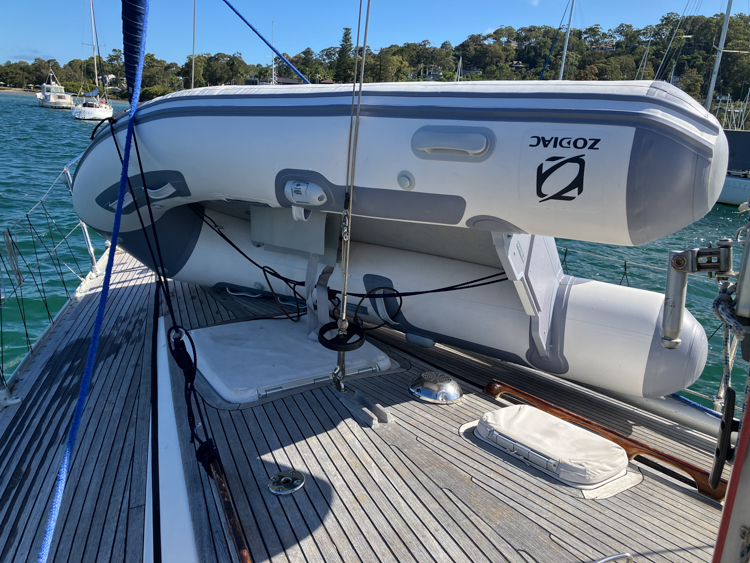
We arrived at Gibson Marina where Peter had a pile of goodies for us, that had arrived by courier. Our most eagerly awaited prize was a brand new Zodiac tender with an inflatable floor, to replace the old Maritim tender that came with the boat. Every time we assembled the metal floor of our old tender, often balanced on a rocking deck, we winced at the scissor-action of the finger-crunching metal side-rails as they snapped into place. The Maritim parts were also unwieldy to store, and it was good to get a dinghy that would just roll up into a duffel on the deck.
Also waiting for us were the yacht’s original Norwegian EPIRB, now recoded to Australian MMSI for a small fee by the lovely folk at GME in Sydney, a new 4kg gas cylinder to accompany the existing one in the gas locker, and 39 metres of green-fleck line to replace our ageing foresail sheets.
Brendon, who had crewed for us on previous legs down from Queensland, flew in from Western Australia to join us aboard, and we spent a little time provisioning and squaring away the new gear.
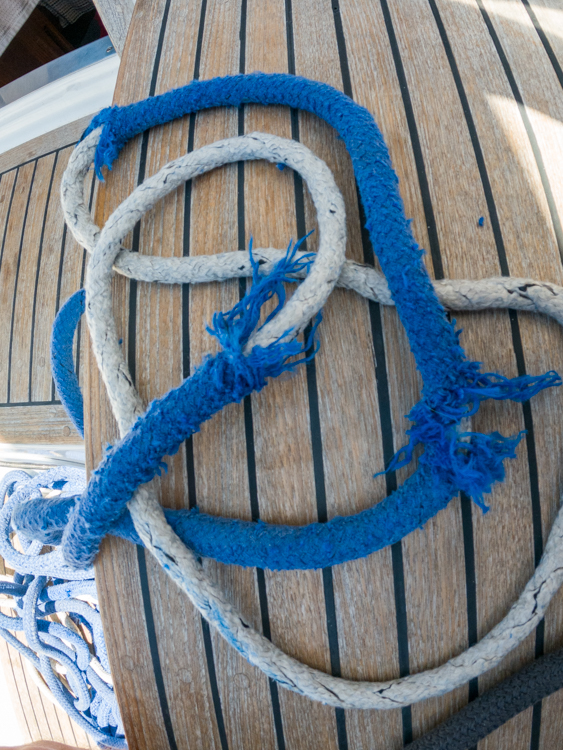
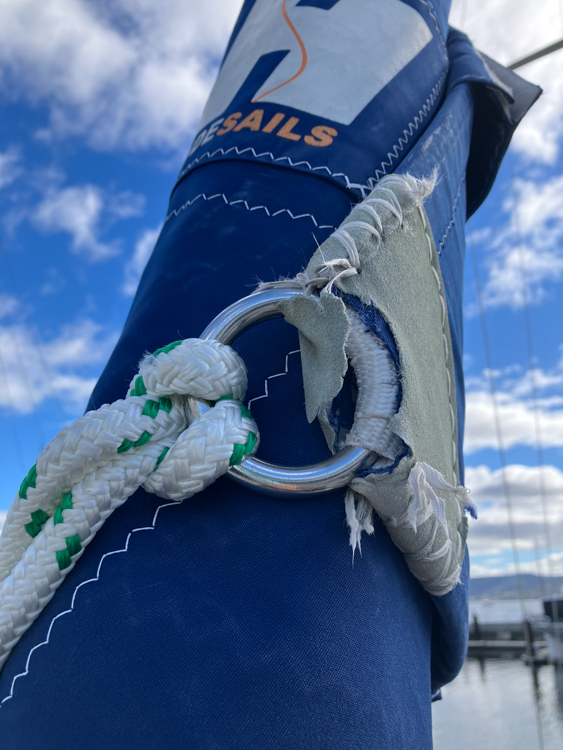
The foresail sheets that came with the boat were a bit of a mystery to us. They were oversized to a point where they didn’t fit properly in the winches or clutches, and terribly worn.
Because of the large rope diameter, the bowline knots attaching them to the clew were big and fat and were always hanging up on the tackle of the cutter forestay when tacking. We replaced the two lines with a single long sleeker line attached in the middle to the genoa clew with a cow hitch.
Taking a moment to load up with diesel at the easy-to-access fuel dock at the Royal Motor Yacht Club, we motored out to a mooring at Coasters Retreat near Barrenjoey Heads to cook a final pre-passage lunch.
Pittwater to Jervis Bay
We soared out of the heads at half past three on the Saturday afternoon, making good ground running under full sail before a light nor’easter. We needed to make an average of 6 knots all the way to Jervis Bay the following afternoon, in time to shelter from a predicted southerly change, and initially all was going well.
The wind speed was forecast to decrease into the evening, so we had expected to do some motor-sailing, but by 18:30, the wind at our position had dropped to 6 knots, below anything that we could use with the hoisted sails. We cranked up the engine, watched the sails flog gently for half an hour as the apparent wind span round and round the clock, and then took them down for the night. We’re not racers, so we like to set the sails at dusk for the worst conditions expected that night, to minimise sail changes and deck work in the dark, particularly as there will only be a single person on watch.
The adults took three-hour watches. As has become our custom, Brendon took the first, Reinhard the second, Bronwyn the third. It was very quiet all night, in the mid twenties centigrade with occasional light rain which we soon left behind. The big Volvo diesel thundered reassuringly through the night until dawn, when the rising sun brought with it a welcome breeze, so we switched off the engine and hoisted sail.
The steady easterly gave us a nice beam reach and we were making 8 knots, which is about our hull speed. The wind was 12 knots, which is within the tiny window in which our oversized heavy genoa foresail is effective, so we left the staysail stowed, and enjoyed the ride.
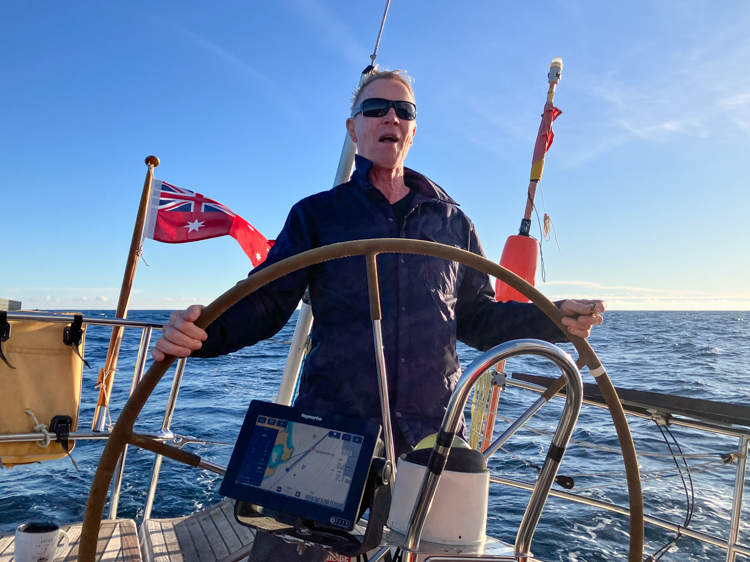
Turning through the heads into Jervis Bay, the wind began to back to the north-west, heralding the incoming cold southerly change. We gave the helm to 10-year-old Berrima, who steered us on a tricky beat round the point of Bowen Island. Berrima is still a little short to see over the bow, and so focussed entirely on keeping the sails set and nudging as close as she could to the wind, while we kept an eye on the rocks for her. She gave us just enough sea room to sneak around the point into the bay.
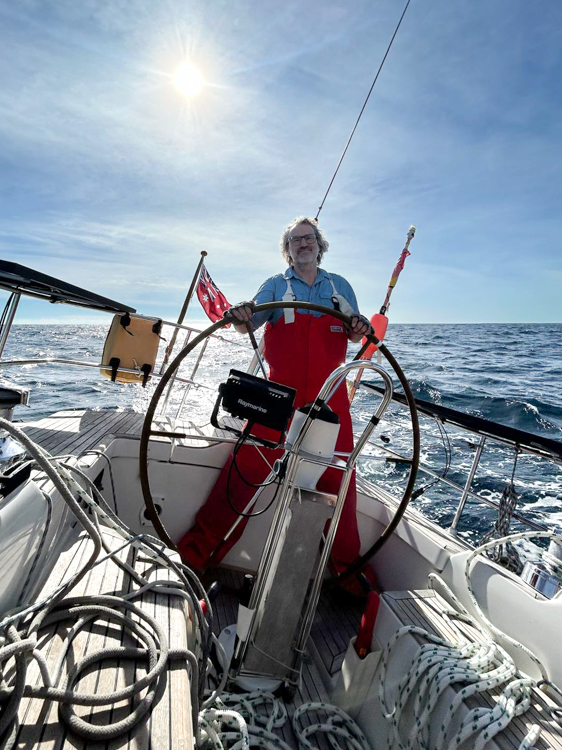
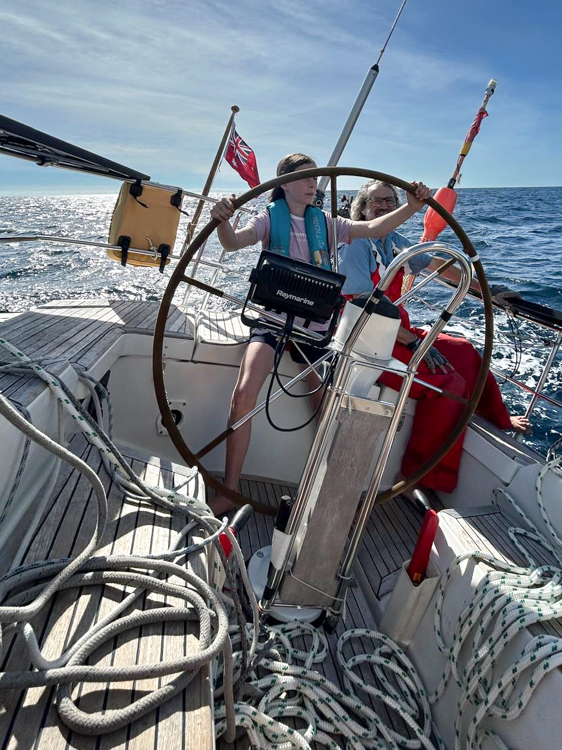
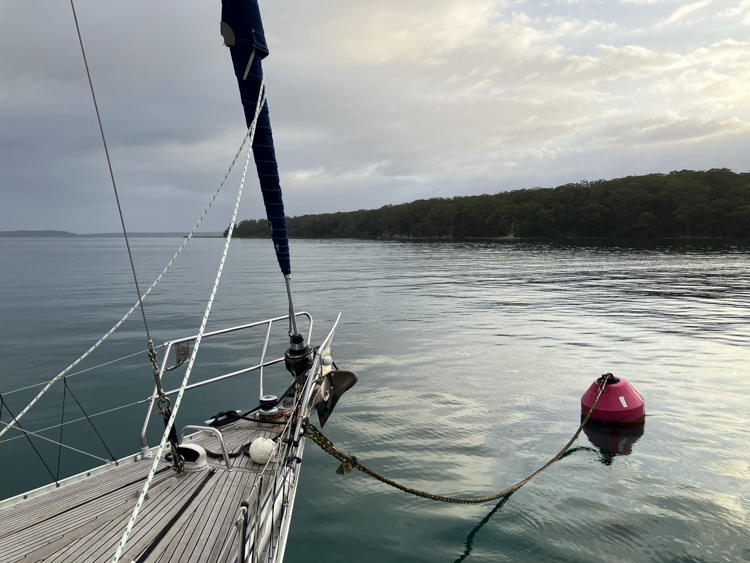
Keeping in mind the enormous distance between lee shores in Jervis Bay, we didn’t want to anchor in the north and then motor for hours to the south when the wind changed overnight, so we picked up a public mooring in the southerly bay known as Darling Road. We were quite glad to find the mooring, because the northerly got stronger and stronger, pushing us toward the Hole In The Wall beach, until the southerly change came in and pushed us away again. We were glad to forsake the anchor watch and just let the buoy do its thing.
A glass of wine, a game of cards, and early to bed.
We awoke after a comfortable night and a long lie-in, intending to spend the rest of the day waiting out the storm that raged out to sea. It was still and quiet in the shelter of the bay, so we took advantage of the time to reorganise.
Up until this leg, we have had only one gas bottle to cook on, and have been using the empty side of the gas locker to store rubbish bags. Now that we have installed the second gas bottle, we needed to find somewhere else to put our waste. We removed all the mooring lines from the starboard lazarette, where they were anyway continually getting tangled up with the autohelm shunt and fenders, and stowed them on a handy shelf that we found at the back of the anchor locker.
Using the extra space in the lazarette, we made a nest out of the canvas wheel-cover (which isn’t in use on passage), and dropped the bin bags into it. Hopefully this will keep them contained and prevent them from splitting. If the idea works, we’ll think about buying one of those 4WD canvas bags as a permanent solution.
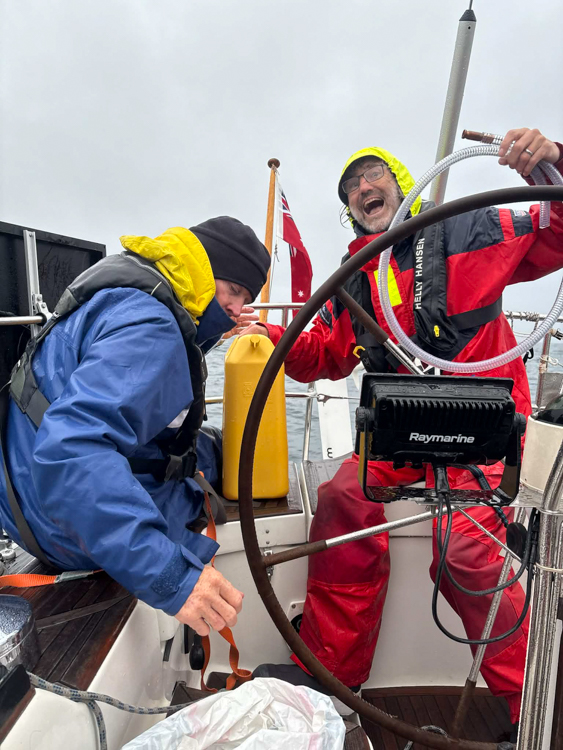
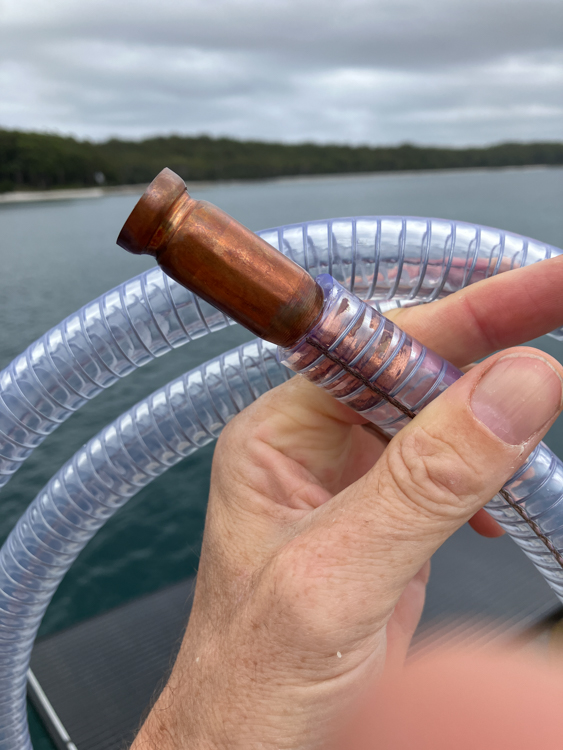
We also used our new jiggler hose – what an amazing piece of kit! Why have we not known about this before? – to calmly and cleanly siphon 40 litres of fuel from jerrycans into the fuel tank. For those who are, like us, late to the jiggler show, this is a simple siphon tube that contains a brass fitting containing a ball-bearing. The brass end of the hose goes into the jerry can. You jiggle it up and down a few times, and the ball-bearing effortlessly sets off the siphon flow. No more sucking fuel with your mouth or dodgy squeeze-tube, or balancing on the swim ladder with a jerry can and funnel…
Poonami
We woke next morning and checked the forecast. There was a weather window clear down the East coast, across the Bass Strait, and in to Coles Bay in Tasmania.
We motored out of the heads and found no wind at all. That’s sometimes the downside of choosing your weather window based on the avoidance of strong winds! We continued to motor most of the day, and then, as the wind picked up, motor-sailed into a light southerly. This gave us 5-6 knots while heeled over at 30 degrees, where Vestlandskyss sat quite comfortably while bouncing through light swell, though the interior spaces of the boat become quite difficult to navigate at that angle, despite clever placement of foot-boards and hand-holds throughout.
Brendon went below to use the head, and came back almost immediately to ask me to have a look. We’d been heeled over to starboard for hours, which incidentally pushes our toilet through-hulls deep under water, and we had been less than diligent about keeping those valves closed. In addition, some days ago I had emptied the holding tank and left the separate valve open to air it out. The holding tank is where poo is kept when you are using the toilet in restricted waters, such as in the marina or a swimming area.
Reconstructing events, one or more pressure-waves caused by the hull crashing sideways into the swell had forced sea water in through the fitting that allows the toilet to evacuate into the sea. Normally this would just fill the bowl with sea water, but because the holding tank valve was open, the jet of water must have bypassed the toilet, washed around the holding tank (giving it a good pressure clean), and then blurted the tea-coloured contents up through the toilet bowl, and then in a neat arc across the wall, and into the bathroom cabinets.
All of our wash bags, toothbrushes, medicines, were awash with brown salty fluid. Brendon did a great clean-up job, and we rinsed the wash bags and hung them on the rail to dry.
A little later the same day, Bronwyn used the head and discovered that the sink was full of clean water, apparently sea water rolling over the deck and coming in through a vent in the ceiling. Still heeled over, every time the boat bounced, an impressive wave did a complete circuit of the inside of the bathroom and returned to the sink, soaking everything in and out of the cabinets along the way. We pumped it out, closed the roof vent, and hung some more things out to dry.
Into Eden
Back on deck, conditions remained stable. Petrels, dolphins, and albatross kept us company. We dined on roast potatoes and tuna mayonnaise. The Milky Way came out above. Bioluminescence shone in our wake below.
The wind swung round to the north, but still blowing too lightly for us to run before it. We furled the genoa, and motor-sailed through the night. The morning saw us under a red crescent moon and clear blue skies, still at six knots but getting a little low on fuel. Memories of our recent empty fuel tank at Nelson Bay were still fresh in our minds, so rather than cross the Strait with less than a full fuel load, we elected to put in at Eden to top up.
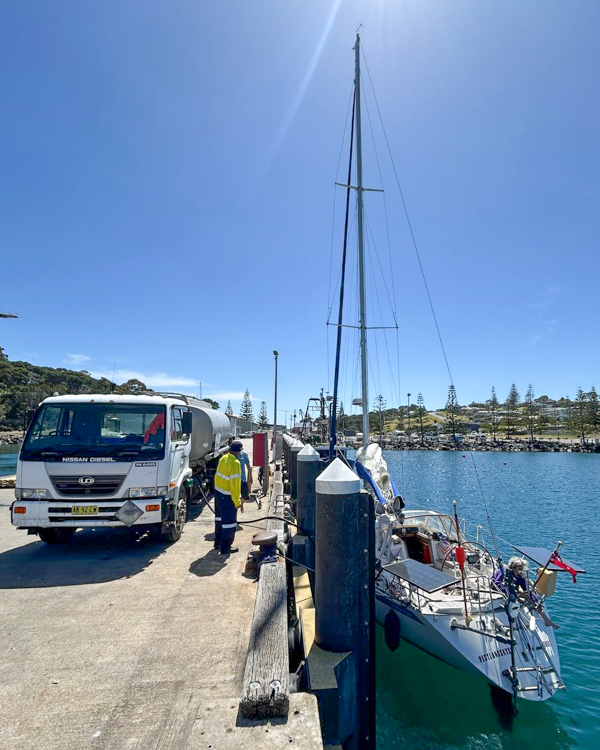
As advised by the Port Authority website, we rang South Coast Ice Supplies and Andrew drove out in a mobile fuel truck to meet us at the commercial wharf. Mooring against the enormous pylons behind the tug boat wasn’t too difficult, and we filled up with a long hose. The wharf was quiet, so Brendon and I walked into town to pick up some supplies, then it was time to leave and continue our journey.
Unfortunately we miscalculated our departure from the light lee shore – we’re still getting used to this boat – and just snagged the edge of the port solar panel against one of the dock pylons, tearing it off its mounts. It still seemed to be working, so we lashed it into place and kept going.
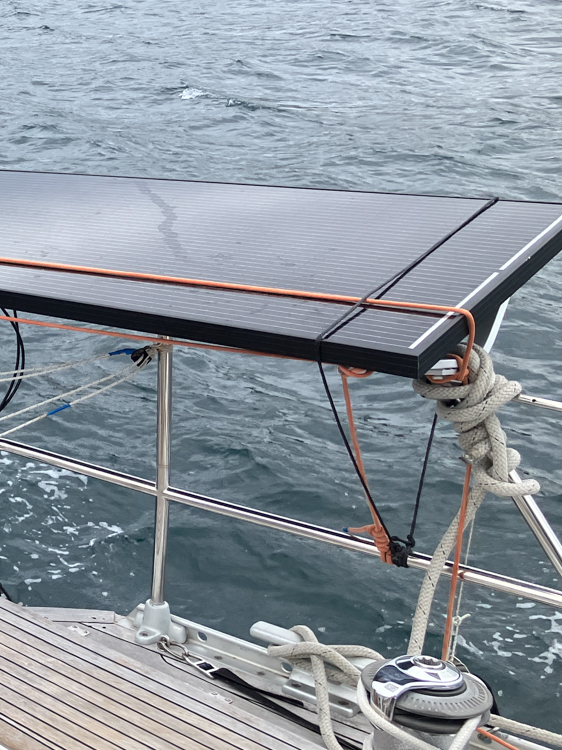
The northerly finally picked up, blowing 15 knots, so we raised sail and headed south at 6 knots. We were on our way to the Bass Strait.
I am always amazed at how much there is to manage on a sail boat …