We’d been scouring the internet for forests for sale, applying our standard criteria for new purchases:
Priced under $100,000
Situated 1 hour from an international airport
Situated 1 hour from an international port
Depressed economy with a likelihood of recovery within a decade
We had found two areas of the world that seemed to comply, eastern Canada and southern Tasmania. There were some nice sea- and lake-front properties up near Halifax, where we reasoned that the economy, which has been in a bad way since the crash in fish stocks some decades ago, might recover if global warming caused the North West Passage to open up and container ships started coming ‘over the top’.
On the other hand, we don’t like Canada’s tax laws, but are already subject to Australia’s, so we had a closer look at Tasmania.
Down in the far south of the island state, much of the land facing the d’Entrecasteaux Channel has been (at least theoretically) subdivided into rural plots. Over the last hundred years there have been several attempts to build new bush towns down there, and the councils hold maps with named roads and numbered plots, but development never kicked off and there is no sign of this on the ground. Mainly it’s all unmarked post-logging new-growth forest. However, the plots exist as legal entities and are all owned by somebody, typically by a local resident who bought them up as an investment. Now those residents (or their descendants) are passing away and willing their land to their children. However, Tasmania has moved on and those children don’t want to live on the land, they want to make their fortunes in the big cities on the mainland. Many of these plots are now up for sale, as those children try to cash up and move on.
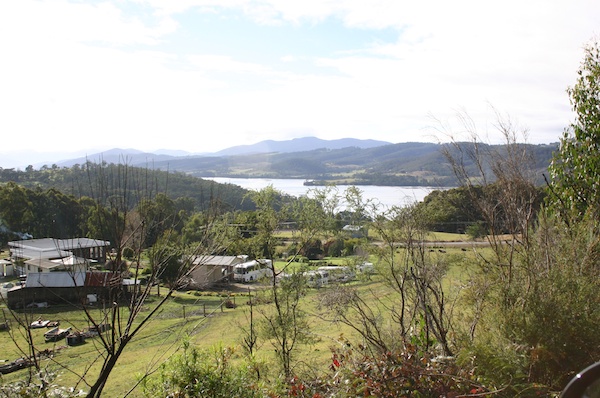
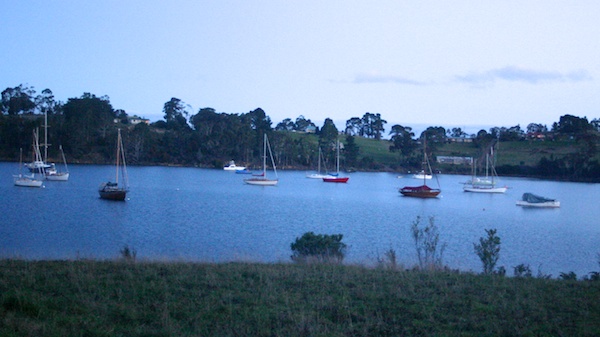
The d’Entrecasteaux Channel near Hastings
Having drawn up a short-list of some half-dozen candidates, we flew to Hobart, hired a car, and spent an enjoyable rainy weekend stomping around in the bush with an obliging agent from Tasmanian Private Realty.
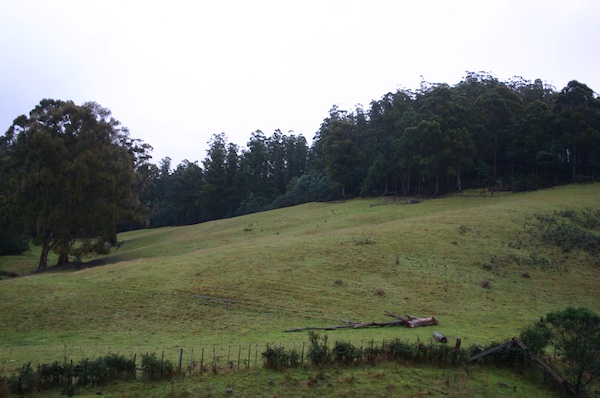
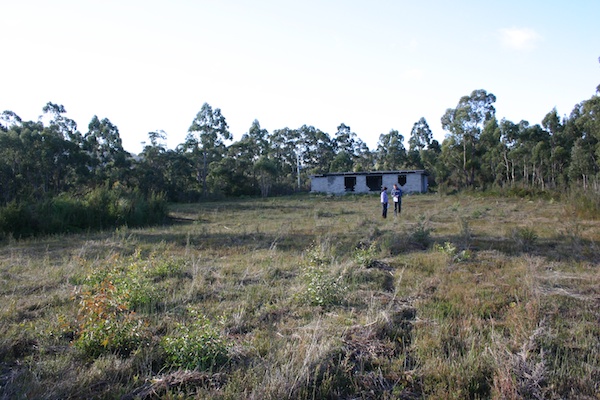
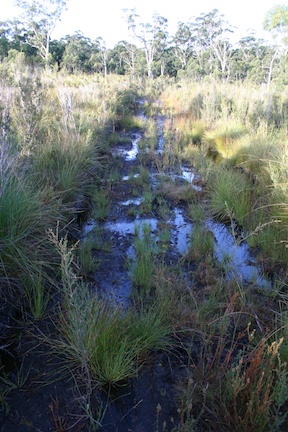
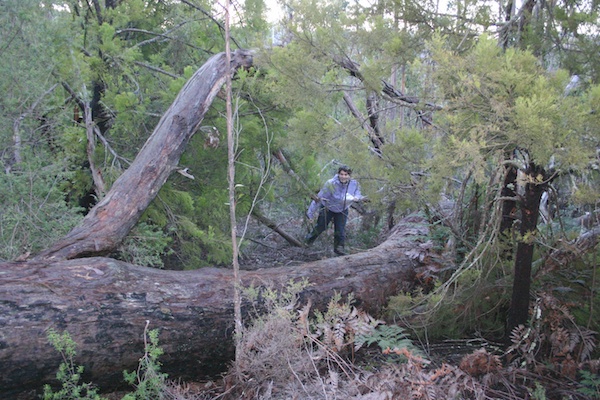
This forest in Cradoc also had pasture land, but we’d need to build a long access road over swamp landNice view from a forest above Franklin, but a little too close to our neighbours, and the trees were a bit scrubbyThis property near Hastings was mainly cleared with a half-finished building in it
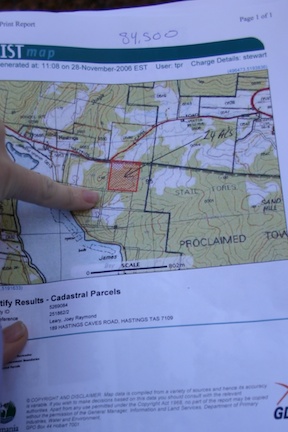
Planned division above Hastings
It’s at the top of a hill and peat bog
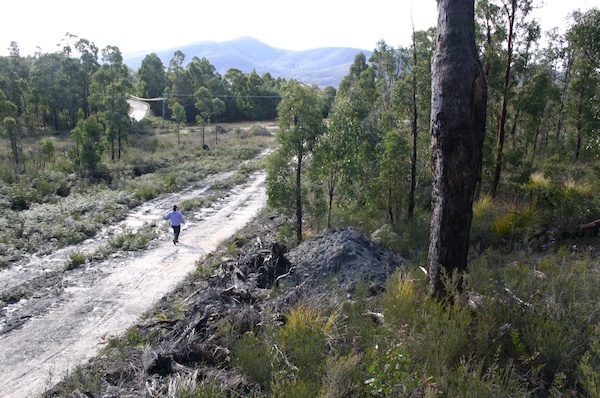
This property in Surges Bay had been logged too recently and hadn’t recovered yet
At the end of a long but very interesting day, we arrived in Lymington where there were three connected plots for sale. It was almost dark as we clambered around in the damp undergrowth, but we liked what we saw and decided to return again next morning.

Wrapping up a good day’s hunting
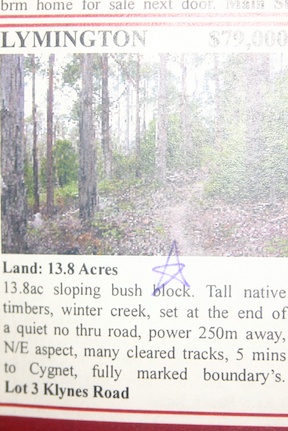
Tomorrow: a likely-looking one at Lymington
We were up bright and early and, after breakfast in the pleasant local town of Cygnet, drove out to Lymington. There was an old logging track that led past Lots 1 and 2, which then petered out before reaching Lot 3. All were for sale. Lot 1 was on the flat with some pasture, Lot 2 sat at the bottom of the hill, and Lot 3 ran up the hill to the top. As was usual with these kinds of plot, there were no fences or border markings of any kind.
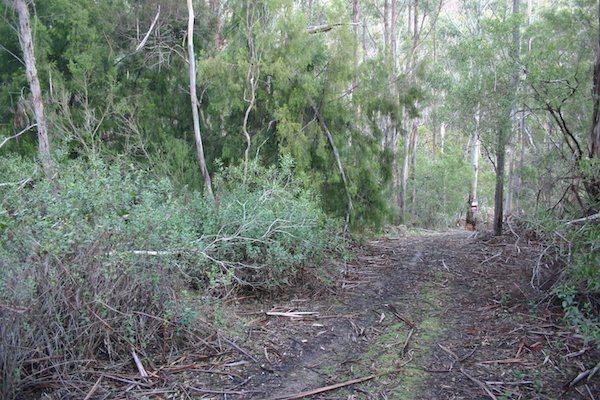
From the logging road, Lot 2 is on the left and Lot 3 can be seen in the distance ahead
We were drawn to Lot 3. It has the advantage of sitting at the top of the hill at the end of a blind road, so it would be very private. The border with Lot 2 is marked by a winter creek. The other three sides of the square border forestry land, and when I rang the council to see if they had any plans for it, they told me that there it was such a thin inaccessible band that it would never be worth anybody’s while to log there again.
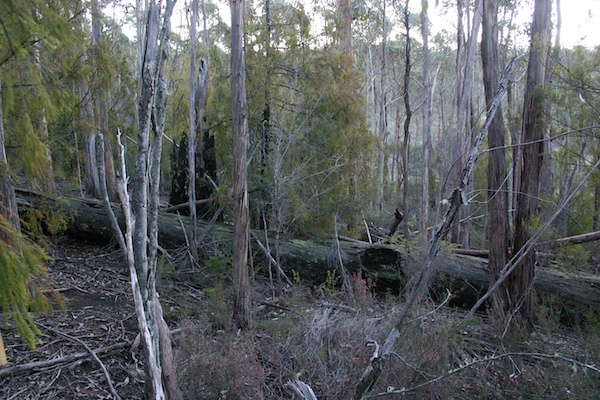
It looks like this property was logged about 30 years agoBronwyn has a good look around in the undergrowth
There is a good covering of different trees of different sizes, and the undergrowth is thin enough to allow access to the whole property. The rural zoning means that we can build a house or not, as we feel fit. As a bonus, Copper Alley Bay at the bottom of the hill has moorings for deep-keel yachts, and – as residents – we would be able to put in our own mooring for a minimal fee. The nearest town, Cygnet, has shops and pubs and a hardware store, as well as some nice little restaurants.
Relaxing here in a clearing, sipping world-class local wine as the sun sets over the blue sea below, I find it hard to believe our luck. We have just bought the forest that stretches for acres all around, but if we need some milk in the morning, we can drive down to the local town in fifteen minutes or, if the mood takes us, we can be at the international airport within the hour.
Indulging in a little light gardening
Our little piece of paradise is in Tasmania, a state that remains largely neglected by tourists and by mainland Australians alike, and yet the lush 68,000 square kilometre island contains some of the most productive land in the southern hemisphere. While the rest of Australia suffers under fifty years of drought, Tasmania not only supplies much of the country’s soft fruit, but also supports a burgeoning and very successful boutique wine industry.
The state largely escaped the Australian property boom and subsequent crash of 2002, and, compared to the rest of the country, land in Tasmania remains cheap and undeveloped. It is true that in recent years, the part of the island closest to the cosmopolitan buzz of mainland Melbourne has undergone something of a metamorphosis, with affluent mainlanders buying up waterside frontage, or giving up their office jobs to start boutique vineyard farm-stays. Later entrepreneurs have since spread out along the coast, with locals scrambling to subdivide and to sell them their previously worthless land.
It is away from these northern areas that today’s bargains are to be found. A year ago, there was still land available on the hills above the capital city of Hobart. Today you should point your car southward, and in only half an hour you will find yourself in the Huon Valley wine region, currently densely thicketed with ‘For Sale’ signs. The larger tracts have been given over to viticulture, but what remains are little pockets of bush, perhaps hard-won fifty years ago, but now often willed to disinterested children who really just want to sell up, split the money, and get back to the city.
Logging is a part of life here, and apart from some rather spectacular National Reserves, there is little standing timber over fifty years old. A typical ‘bush lot’ comprises up to twenty acres of young gum trees for up to $100,000, a price that could also get you a mere handful of acres of cleared building land with water views. Having done most of our research on Tasmanian Private Realty‘s excellent website, we only needed a single weekend to view our shortlist before settling on fourteen acres sloping gently down towards the sea.
Sold to the happy couple
Mistress of all she surveys
Cygnet is the closest town. It is typical of the area in that it comprises a simple line of a few homes, some local businesses, and three pubs. When we spoke to the new owners of the Top Pub where we were staying, we found that they were renovating the upstairs into a boutique hotel. The nearby Red Velvet Lounge restaurant offered a gourmet menu featuring locally farmed salmon and organic produce, and there was talk of a new deep-water marina close by. These are not the hallmarks of your average bush town, and so it seemed to us that now was the time to buy.
We intend to build a small home in a clearing, but could equally well put up a series of guest lodges. That’s all in the future, though. For the moment, we are content to sit and sip our wine and enjoy the views.
We’re about to head off on a sailing adventure, so we popped down to our Tasmanian property to ensure that we’d still be able to locate the boundaries on our return. We’ve replaced our original surveyor’s marks with fresh tape and put in some boundary stakes.
It’s important to know your boundaries
Following the edges
We also decided on the location of our house, which we intend to be built on a high deck to provide views out over the tree tops. We’re currently considering a round yurt design, so we’ve staked out a ring.
Staking out the foundations.
While buying stakes and marking tape at the local garden centre, we decided that we might as well do some gardening as well, so we planted some soft fruit.
Raspberry canes
Nut tree with truffles (maybe)
Really, though, the whole idea is to camp out here in complete seclusion, and enjoy the forest.
Now that we had purchased our forest in Tasmania, we had a great camping destination (albeit one where all our gear needed to be packed in over the creek on foot), but where should we build our house?
Our steeply sloping 2008 camp site. Note the staked retaining wall/ foot rest to stop us from rolling down the hill.
With 14 acres of dry sclerophyll forest to choose from, we spent several visits stomping about, clambering over fallen trees and poking at the ground, we slowly formed a more detailed mental picture of the terrain. The high Southern slopes are steep and rocky, and the low Northern slopes are steep and boggy. To the East, the land falls away steeply to one side. To the West lies the official route of Klynes Road, although in reality there is little more than a rough logging track which terminates at the creek crossing on our border. Still, it is the closest thing that we have to a demarcated border with the farm on that side, so we didn’t want to build in sight of it in case something changes there in the future.
In the end, we decided to put the house on a shelf of less steeply sloping land, more or less in the middle of the forest. After a lot of scrambling around and climbing trees, we ascertained that a raised deck would give us fine views across the d’Entrecasteaux estuary, over the tops of our lower forest. The higher wooded slopes to the South would protect us from storms rolling in from the Southern Ocean. Bravely, we hammered some stakes into the ground.
How about right here? The site in 2008.
It was still only coloured sticks in a forest, with no access except on foot by crossing the creek at the bottom of the property. However, a neighbour who had built a house further down Klynes Road had access to a bulldozer, so we commissioned him to run a causeway over the creek, push through an access track, and clear the brush from the building site.
2007
2012
The house is gonna be here! The brush cleared in 2012.
We’d asked him to leave the larger trees for the moment, but to clear anything that had fallen down. This had the unexpected benefit of providing us with chest-high stacks of drying fire wood which will probably last us for years.
Perched atop just one of our little piles of firewood.
We have no immediate plans to start the house build; all that is far in the future. But now that we can get a four-wheel drive in to our cleared building site, we have a perfect camp retreat at the bottom of the world.
Home away from home. Our considerably more comfortable camp site in 2012.Making good use of the wood pile.
For several years, all of our camping gear had been stored under a bush, wrapped in a tarpaulin. On every visit, we found more holes in our tarp, and sometimes nibble-marks on the tools themselves. We decided to construct a more permanent shelter for our gear, and to this end bought a prefabricated garden shed and some railway sleepers.
Digging the foundations for the shed. It’s nice firm clay down there.A man and his shed.
We had chosen a build site in the middle of our forest, and had at least made a start on putting in an access road and clearing some space. But what next? What kind of house did we want to live in, and who could we get to build it? Would it make sense to do it myself as an Owner Builder?
We knew that whatever we built, it would be off the grid and self-sufficient. Even though such structures are increasingly common in Tasmania, it seemed to us that it would be sufficiently non-standard that we wouldn’t find something off the shelf, and perhaps we would be best off managing the project ourselves. To this end, I began investigating the requirements to attain my “Owner Builder” qualifications, which would give me the legal ability to build my own house in Tasmania.
It turned out that there were two components to this; the “White Card” which is an industry standard health-and-safety qualification that is essential for working on any building site in Australia, and the “Owner Builder Certificate”, which is a specific course to prepare you for the job in hand.
White Card
An Australian White Card is a pre-requisite for any construction activity, and the terms and conditions vary between Australian States. Whichever card you get, though, it is valid in all other Australian States… and some States don’t allow online training… and you don’t need to reside in a State to apply for their card… and the Western Australia card is available online and differs from some others in that it does not have an expiry date. I couldn’t see any reason why I shouldn’t get the open-ended WA card, so I registered with EOT online training and got one.
The course was inexpensive and interesting, with a face-to-face component which involved videoing yourself giving answers to some of the longer questions which are reviewed by the trainers. There was also a slightly bizarre requirement to film yourself correctly wearing your Personal Protection Equipment, so I took the opportunity to kit my daughter out as well.
Bunnings also sell PPE for small people.
Owner-Builder
The Owner-Builder qualification is a bit more involved, but is also available inexpensively online. I took my course with ABE, and began a fascinating journey into the intricacies of controlling a building project. One theme that continued throughout the various modules was to think carefully about whether you were up for it; are you capable of managing your time, managing people, managing a budget? Is your family prepared to support you throughout the inevitable stress? Are you really prepared to give up so much of your time?
It really is a very good course, and at the end I felt a little nervous but at least mentally prepared for the challenges to come.
We had long been interested in the idea of building a yurt or round house in the woods, even travelling to Mongolia to stay in an original felt-walled ger.
Our ger on the Mongolian steppe.
These gers are designed to be stripped down, packed up and moved at regular intervals, stemming from the traditional nomadic lifestyle on the Steppes. With the breakdown of the USSR and their enforced “westernisation” of Mongolians, there is a resurgence in their use, particularly noticeable today in construction sites as the workers move from site to site.
Gers in use by construction workers in Ulaanbaatar.
There is quite a movement around the world to take the same easy-to-erect construction concept but with the view to building a more permanent structure. Some companies used modern fabrics, others made the walls from wood. In all cases, the result is a polygonal structure with a large open space inside.
Australian Roundhouses
We looked at a few different companies, several in the US where this sort of thing has been going on for some years, but eventually settled on Australian Roundhouses (formerly Goulburn Yurtworks) just outside of Canberra.
A design from Australian Roundhouses.
The team were enthusiastic about prefabricating the structural elements in New South Wales and driving them to Tasmania on a low-loader to erect them for us. We had an entertaining time discussing various options and layouts; the polygonal plan provides a fantastic airy openness inside, but does present problems when most of our modern furniture is designed to fit inside a square box. Still, everything seemed to be going pretty well with an 8-metre central round house surrounded by a ring of “annexes” to give extra space. The central roof cupola would provide natural light, and the full-height windows and raised exterior deck would give us unrivalled views across the d’Entrecasteaux Channel.
We edged ever closer to an agreement, and the builders got ever more excited about their upcoming Tasmanian “holiday”. Then we realised that we might have a problem with the 49 foundation posts on which the structure would stand. They would add appreciably to the weight of the trailer which needed to cross to Tasmania on the ferry, so I agreed to look into sourcing them locally. Since the site is sloping, with a drop of a few inches to the South and about 3 metres to the North, a half to a third of the posts would need to be longer than the standard length in which such poles usually come. The longer ones, up to perhaps 4 or 5 metres, would all be “special order” and priced accordingly…
And then we started factoring in all the extras that we would need once the main structure had been constructed. Dry-walling, plumbing, electrical, waste, all would have to be added after the builders had gone home. Even the rough estimates started to blow our budget. We needed to reconsider.
Neat House
Perhaps we could get away with a smaller round house for our living area, and combine it with a more traditional structure for the services? We looked into a company called Neat House who prefabricate buildings in Tasmania using local materials.
This would use fewer long foundation posts underneath the yurt, but now we would be dealing with house components from two separate suppliers, plus additional labour to glass-in the connecting corridor between them. It was all starting to get a bit complicated, so we went back to the drawing board.
After considering some lovely (but ultimately impractical and over-expensive) round house options, we have realised that we need to pay less attention to the fluffy design tasks, and more attention to supply chain logistics and to the post-lock-up finishing and decorating. To this end, we decided to investigate a prefabricated house.
We started out looking at “tiny houses”, which are a bit of a fad at the moment. Technically a caravan in that they possess a wheeled chassis and are thus immune to building regulations, they are not meant to be towed around on a regular basis and are commonly installed as a granny flat in a suburban garden. A tiny house can be a marvel of interior design, and we found that we were familiar with many of the principles because it is similar to that found in yachts, where space is also at a premium.
A typical Tiny House, the Hauslein Sojourner
Although tiny houses are very interesting, and a good way to create some extra living space in a confined area, they are relatively expensive per square metre because of the necessity to cram everything into a small footprint, and anyway we have plenty of space to spread out and no need to unnecessarily limit ourselves.
There are other styles of prefabricated house, that can give you a larger footprint. Around Australia, there are a number of businesses which will build a house for you in their factory, all the way to completely decorated with all utilities and appliances installed. The house is then cut into pre-defined segments and delivered to the site on a low-loader for re-assembly. The advantage is that the builder has complete control over all aspects of the build using their own staff, and can thus deliver significant economies of scale as well as an agreed price and timeline.
We chose to move forward with TasBuilt Homes after visiting their rather amazing factory in Launceston.
Tasbuilt Homes factory, containing a house in progress.
The way it works is that you take one of their standard designs, and then move around the internal walls and fittings until you have the result that you want. The guys at TasBuilt were very friendly and obliging, and we had an excellent set of discussions with them, specifying all the finishes and adding a North-facing deck. Since the price was all-in, there were going to be no surprises, and we were pretty happy with the plan.
All was going swimmingly well, until TasBuilt sent their surveyor down to look at our access road, which was then under construction. They approved of the road that we were building across our property, but were less happy about access down Klynes Road itself. TasBuilt’s surveyor judged that it was too narrow and too steep to negotiate with a 6 metre wide trailer.
Klynes Road survey notes
Although this is officially a council road, we are not averse to running a bulldozer down it or cutting back some trees if we need to, because we are the last property on the road and it doesn’t go anywhere else. However, there were places where we would have had to double the width, which would entail substantial earthworks and the loss of some beautiful well-established trees, so we regretfully decided to return once again to the drawing board.
Back in 2012, we asked Matthew, a friend and neighbour who had access to useful machinery, if he would help us with bulldozing a road into our property. We asked him to make it as subtle as possible, just a winding bush-track through the forest to give us initial access, without materially changing the look and feel of the site. Matthew made us just what we wanted, a dirt track just perfect for humping camping gear in and out of the forest.
The entrance to the track from Klynes Road into the property, freshly built in 2012.
I had an idea in the back of my mind that some day we’d need to widen it to give access to construction machinery and to serve as our official Rural Fire Service access road, but for now this would do us just fine.
Since the “official” council road, Klynes Road, was merely a dotted line on a map rather than an actual graded thoroughfare, we also got Matthew to clear a line along its path up as far as our track entrance, adding a turning circle for delivery trucks, for when the time finally came to build something. Nobody else uses that end of Klynes Road, as it doesn’t go anywhere, so we felt that nobody would mind.
Then we went travelling abroad for a number of years, and returned with a small child. This re-focussed our minds on the building project, which had heretofore been a nebulous plan that we would think about somewhere in the future.
The first step was to evaluate what had happened to our property in the intervening six years. Was the access track still open? Was the cleared building site still accessible? We hopped on a flight to Hobart and rented a small car with a child seat.
We had no idea what we might find, or even if we’d be able to find the track. Nature can reclaim a lot of land in six years! This video records our arrival.
Track entrance in 2018Top of the track in 2018
The track was still there, overgrown with ferns in places, and obstructed by fallen branches and the occasional tree. We cleared it all away, but found that the compacted mud of the track bed had eroded in places to reveal a lumpy surface of loose sand, projecting tree roots and slippery stumps, and there was no chance of getting our two-wheel-drive rental vehicle up there. We did come across a flat hard-standing that had been built by a gate to our nearest neighbours’ property (the farm on the other side of Klynes Road), a gate which hadn’t even been there six years ago. Now that we’d extended Klynes Road as far as our boundary, there was no reason why our neighbours shouldn’t make use of it, and they clearly had. It made a useful place to park the car, while we unloaded.
This is as far as we can get in this vehicle! Looking down from the track entrance.
Our storage shed, now six years old, was still standing on firm foundations, with all of our camping gear refreshingly un-nibbled by the local wildlife. After moving out the bulkiest items, we used the shed as a rain shelter for cooking and eating. Berrima, age 3, instantly fell in love with the forest, and with the whole idea of bush camping.
I had been worried that we would need to have the building site itself cleared again, but in fact it looked much the same as we’d left it six years earlier. I had deliberately left the tall trees standing while clearing away the scrub and litter, and I guess that’s the advantage of dry sclerophyll forest; all of nature’s action is far up in the tree canopy, and nothing much happens on the ground. There was just some Common Heath, a pretty but slightly prickly flowering native, and some bracken under the sheltering native cherry trees.
The house site, looking North, 2018.
Having established that everything was fine with our forest, we went back to work. A year went by, while we worked on contracts far away in Queensland and in the Australian Capital Territory. In the evenings, though, we planned and plotted ways to fund and build our final home.
Doing our research and due diligence, I became aware that the Rural Fire Service regulations had changed. When we’d put in our original access track, the requirement had been a maximum slope of 1 in 4; now the legislation had been upgraded to no steeper than 1 in 5.5 and at least 4 metres wide. Before we would be permitted to live in any planned house, we needed to build a new road.
I commissioned a surveyor to provide us with a contour survey of the site and track. This confirmed that not only the track but also the final rise of Klynes Road was too steep, and the surveyor went back to research the slopes further downhill. Once this was done, I plugged his figures into a GIS program, and then spent several months trying to combine the often contradictory information from this and our previous surveys, mud-map sketches, and paper documentation, to form a coherent picture of our site.
2010 mud map2019 site plan
Poring over the numbers, I mapped out a potential contour route for an access road that would meet fire regulations, would be strong and wide enough to take heavy construction vehicles, and yet wouldn’t spoil the feeling of arriving at a remote bush block. In the 2019 site plan to the right above, you can see the wide green road skirting the Easterly limit of the contour lines.
The map is, of course, not the territory. For all I knew, there might be stands of important trees that I would not want to see felled, or other surprises that could only be determined on the ground. Since I was still working far away in Canberra, I also needed to find somebody with the necessary equipment and experience to get the job done in my absence. I boarded a flight to Hobart.
As luck would have it, it was pouring with rain that weekend, although this had brought the Common Heath into bloom across the entire 14 acres, which was quite beautiful.
Flowers of the Common Heath, the only plant to have reclaimed the cleared land.
I had intended to camp on the land, but instead elected to stay in a local B&B that had the advantage of heating and the internet. My rental car, a tiny hatchback, was obviously never going to make it up our track, but I figured that I would load it up with surveying equipment, stop short on the final drop of Klynes Road down to our creek, and hump in my gear on foot. I was quite surprised to discover that our neighbours had, in the act of putting in a boundary fence, extended Klynes Road right past our property and up over the next hill.
I had a rare old time stomping around in the mud, translating my mapped intentions onto the ground, and finding that yes indeed there was a slightly better route through the timber, one which avoided felling some of the older trees. I spray-painted and marked the route, while wondering who I was going to find to do the actual work.
Let’s put a road through here…
Back-tracking to our border with Klynes Road to check my figures against my boundary markers, I came across a large yellow digger parked on the fence-line of the farm on the other side.
Aha! I thought, and rang the neighbour whose fence this was, and before very long was in contact with the Dan, the Cat’s owner, who agreed that it made perfect sense for him to work on my project once he’d finished the fence-line, since his machinery was already on site.
Soon enough, the road-building project was under way. Perhaps ironically, the very first thing that Dan did was to widen and re-open the old track, so that he could get his digger up to the site. Now we are the proud owners of not one, but two roads.
Clearing the bottom of the new roadClearing the top of the new road
Things quietened down a bit until after Christmas, when Berrima and I arrived at the end of a road trip to escape the 2019 bush fires. We had a good laugh “going on an expedition” (looking for and re-marking our boundary markers), setting up a tyre swing, and doing some bush artwork.
An Expedition to the South West Pole.
I also took the opportunity to finally clear the trees from the building site.
The building site, looking North, early 2020.
With actual physical labour and a changing skyline, it finally felt that I was achieving something. The site became brighter and sunnier, and the final shape of the view over the d’Entrecasteaux became more obvious. As well as Dan the digger, David the builder and Rodney the quarryman also visited, and we were able to point at things and make real decisions; it felt like we were making actual progress.
There is a bend at the bottom of the new road that is slightly too steep to drive up if the mud is wet. Even the Land Cruiser couldn’t get up in the rain.
The car goes up.. and slides back downresident artist made us a number
Between Dan and Rodney and I, we formulated a plan. Dan would do some more levelling to straighten out the bend as much as possible, and then Rodney would drop a 1.5 tonnes of 60-100mm aggregate next to the creek. Dan would level it, and then Rodney would drop a second load. Once this had been bedded in up to the top of the bend, Rodney reckoned that the gravel trucks could negotiate the bend by themselves, and lay the rest of the 13 tonne loads themselves using the tipper and dragged chains.
Today, the first load went down, and the creek crossing looks marvellous.
The first load of aggregate at the creek crossing, looking North down Klynes Road.
Having exhausted the possibilities of round houses and prefabricated houses, it was back to the drawing board once again. We had been trying to make the project easier for ourselves by getting major parts prefabricated and delivered, because we were working interstate and would not have daily oversight of the construction. One obvious solution was to move to Tasmania and personally supervise the build, but we had temporarily lucrative work in faraway Canberra which we still needed if we were to complete the project. Perhaps it was time to stop trying to make things easy, and get somebody to build a bespoke house for us on site?
We initially approached Davies Construction, who were happy to build something that resembled our previous designs, and provided some reasonable-looking cost estimates. We were feeling quietly confident when they backed out at the last minute, saying that they had just completed a build across the river in Franklin, and found that the travel distance of their sub-contractors was too onerous. I suspect that in reality our project was too small to be of interest to them.
Then we started discussions with the amazing David Kapel, a build manager in Launceston. David was excited by our project from the beginning, and took all of my carefully assembled quotes and estimates and agreed that he could meet almost all of them himself. He would handle our entire build, including all sub-contractors, from breaking the ground to the final finish, including electrical and plumbing work, for a reasonable price.
The way that he was able to achieve this was because the main structure of the house would be made from baulks of cedar, imported already cut and shaped to the owner’s specification by the Scandinavian company YZY Kit Homes. YZY had an agent close to our house in Canberra, who was happy to show us around some demonstration houses.
YZY Kit Home “Madeira”.
Being made of thick timber, these houses are sturdy with excellent thermal insulation, and the parts are easily transported. We were shown a house like the one above, broken down into components and ready to be packed into a standard shipping container which would easily fit down our road.
YZY Kit Home structural members ready for transportation.
Nothing was too much trouble for David, and he even agreed to a fixed-price contract because he was interested in having a show home in the south of Tasmania. We met him on site and discussed access, and we discussed turning circles and trees that needed to be removed, and the levelling of a space on which a 40-foot shipping container could safely be offloaded using a side-crane.
Over the months, we worked out interior decoration, decking materials, and different methods of achieving (and in fact exceeding) our required Bush Fire Rating.
Based on the YZY Madeira, our final plan.
We moved forward with grading our access road, and I got busy with the chainsaw to clear the building site. We put our property in Montevideo up for sale to free up some cash, and got down to the final fiddling details of the placement of light switches and power sockets. We were onto a winner.
Then disaster struck. Due to a family emergency, David had to pull out of the project and shut down his construction company. We were devastated.
YZY were still happy to supply the kit, but did not have any other licensed builders in Tasmania. Still in shock, shattered and not a little depressed, we drew a line under the whole idea of house-building, and went to look at yachts instead.
It took a little while to work it out of our system, and we looked at a lot of yachts. In the end, though, we couldn’t really find what we wanted for the amount of spare cash in our pockets, so we returned home to sulk.
Then we heard once more from David; his son, whom we had already met, was interested in taking up the reins of the family business. We slowly restarted our negotiations, and were just in the process of pricing up a second design option, when COVID-19 became a worldwide pandemic. Transport prices from Scandinavia went through the roof, as all the world’s empty shipping containers ended up rusting in China awaiting cargoes that never arrived. The Australian dollar went into free fall, and the supply chains of imported building materials broke down. Tasmania closed its borders to non-essential visitors.
We hope and trust that we will all get through this, but until the crisis is over, that’s the end of our story.
If, Gentle Surfer, you have been following our blog from the beginning, then you will be wondering what happened to our off-grid house in the forest.
Once the COVID-19 pandemic shut down all the State borders, it played merry hell with our logistics and we had to temporarily abandon our plans. I had paid off the landscaping and road-building contractors without ever seeing how far they had got with their work. This was my first opportunity in almost a year to see what the site looks like today.
My first priority was the state of the new road into our property. I had arranged, over the phone, for dozens of tonnes of rock to be spread up the lower reaches of the road after it had been levelled, but had no real idea how far the contractors had got or what it was going to look like.
In the event, too much loose rock had been laid over the load that had previously been compacted, making it hard going even for our rented 4WD, and the top part of the road had no aggregate at all, and was starting to grow ferns.
Evidently I’ve got a bit of work to do on the road, over the Summer!
Lower slopes good……upper slopes bad
My second priority was to see just how much levelling had been achieved on the actual building site. The contractor had been working on a cut in which we were to build our 6×12 metre shed-cum-solar-farm, and all I knew was that he had made some progress and then had had to stop when the track motor burned out on his digger, for which he was unable to source spare parts due to lockdown in China.
Now that we’ve shifted our primary residence to our other project, we don’t need so many solar panels in the forest and thus such a big shed, but I wanted to know how much levelling had already been done and whether we could build a smaller structure there. At the very least, perhaps we’d have somewhere flat to camp when we visit…
In the event, Dan had done most of the digging-out and about a third of the levelling. It’s not ideal, but is a good start to work with once we finally get down there.
Probably big enough to put a tent on
As for the building site itself, well, it’s still liberally scattered with the timber that I felled on my last visit, now nicely overgrown with ferns. My immediate plan is to clear the timber, split it into firewood, build a solar irrigation system, and plant vegetables.
One day, we’ll still build a house here
Once the current house build project has finished and we’ve settled in to our new home, the forest will be waiting just down the road. We certainly haven’t given up on that project and have already started thinking ahead and making plans.
As they used to say in the newspaper trade, watch this space!
It all started out so simply. Since we had been forced to put our plans for an off-grid house in the forest on the back burner, and had quickly built a different house on an urban block nearby, we were left with 14 acres of woodland which would provide us with an endless supply of firewood and the odd camping weekend, and… what else?
I could grow vegetables. And perhaps honey. Maybe ducks.
But let’s start with vegetables.
I decided that my preference would be to work in 10m x 5m plots. I find that area easy to handle with manual tools and, let’s face it, the dimensions make the math easy. Having several identically-sized autonomous blocks, rather than a rambling smallholding, also means that if disaster (irrigation failure, possum attack) visits one block then I haven’t lost everything.
The land slopes at around 8-10 degrees, so I needed to choose my sites carefully if I was to avoid repeatedly staggering up and down from the tool shed. Given that our access road leads only to our putative building site, and that the site itself is still largely covered in freshly felled trees, my options were somewhat limited. In the end I chose a slightly undersized area close to the tool shed, near to a line of native cherry and sedge which appear to define an underground seep.
The soil
I unlimbered the trusty mattock, and set to work.
With the area cleared of Common Heath, ferns and debris, I set up a 1.8m fence to keep out the wallabies and possums, and dug over to about 10cm. The soil is sandy clay, and pretty easy to manage.
The soil may be easy to work, but it is very poor quality. After some manoeuvring, a helpful fork-lift driver at Horticultural and Landscape Supplies north of Hobart managed to drop a cube-and-a-half bale of SeaGreens kelp compost onto my trailer. I somewhat gingerly towed it to Lymington, and got it up the track.
It took a little while to shovel it out and dig it in, but the plot started to look pretty good.
It was the height of Summer, and the ground was bone-dry. No matter how good my compost, no seeds were going to sprout in these conditions. It was time to install some irrigation.
The irrigation tank
I reckoned that a 2000 litre rainwater tank was probably the biggest I could handle by myself, and should be equal to the needs of my vegetable patch (but read on!).
There are many suppliers of rainwater tanks in Australia, most of whom operate on a just-in-time build-and-deliver business model, which didn’t suit me because access to the property is still problematic, particularly for delivery trucks. However, I happened to be out at Global Poly investigating pumps and cartage when they mentioned that they almost always keep some spare 2000s on the forecourt. I put one on the trailer and took it home.
The builders at our new house in Kingston had finished work, and had left behind a pile of surplus blue-stone from their installation of our household rainwater tanks. Berrima and I shovelled about a tonne into a bulk bag on the trailer, towed it to the forest, and spent a happy afternoon crafting a tank stand.
Now I needed a way to fill up the tank. In the future, I have grand plans to fill all my irrigation tanks from the roof run-off of an oversized shed, but that project is still just a twinkle in my eye. In the meantime, I needed to sort out cartage. There are a number of local water cartage firms who will bring a tanker to your property, but again I was concerned about access for heavy commercial vehicles, so I decided to create my own cartage system.
Water cartage
Originally I looked around for a second-hand Intermediate Bulk Container (IBC). These metal-bound plastic tanks are designed to be handled by a fork-lift and are used all over the world to deliver all kinds of liquid products. They fit neatly onto a trailer or in the back of a ute. It’s usually possible to pick up a food-grade IBC at a reasonable cost, but with COVID playing havoc with the logistics, this was not a good time to try to find one in Tasmania.
Once again, Global Poly came to my rescue. They sell compact ‘Fire Cubes’, designed to be used in conjunction with a generator and a pump in fire-fighting from the back of a ute. At 900 litres, a full tank would exceed the carrying capacity of my trailer, so it would take three partial loads to completely fill up my irrigation tank, which seemed acceptable.
Have tank, will travel
I already had a spare generator that I’d bought for the convenience of the tradesmen working on our Kingston house, and a simple Chinese pump only set me back a hundred dollars or so from my friends at Global Poly, so I was good to go. I pumped water into the cube from my house rainwater tanks, drove to the property, and pumped it back out. And repeat.
Pumping rainwater from the trailer into the irrigation tank
Drip Irrigation
I had previously set up small household drip and spray systems running through timers under mains pressure, but I had no real idea how to set up a gravity-fed system on this scale. My gut feel was that, unless I wanted to mess around with tall tank stands, I would need an electric pump to run the system, but I was open to the suggestion of letting it flow out under gravity. There’s a great deal of conflicting and often quite complex advice on the internet, and I wasn’t able to make a firm decision. I did notice that Hobart company Hollander Imports received a lot of local praise. They don’t have a proper web presence, only a Facebook page, so I drove into Hobart and ambled into their office, hoping for some advice.
The gentleman behind the desk listened carefully as I described the size of the tank, the size of the plot, and the slope of the land, and then pronounced the site ideal for a gravity feed system. He loaded me up with coils of piping, constant-pressure drip line, and handfuls of taps, joins and clips. He reckoned that the constant-pressure line would compensate for the change in pressure as the tank emptied, and would provide an even supply of water. He also recommended that I didn’t bother with all the fancy delivery-and-collector patterns published on the internet, but just to run both my plants and my drip lines downhill from a horizontal feed pipe.
Constant feed drip line (brown), irrigation piping (black) and a bag full of parts
The plot is 40 minutes from my house, so I needed a way of automatically turning it on and off as I didn’t want it dripping 24 hours a day (I had nowhere enough water for that!). Hollander Imports sold me a battery-powered mechanical timer, which controlled a simple flow gate.
I took all of it up to the land and, leaving the timer aside for the moment, connected the plumbing components together in their approximate final configuration. I manually opened the tap on the irrigation tank, and it all worked perfectly.
Approximate set-up for testing
I unplugged the piping from the tank valve, and inserted the timer into the line. It toggled on and off correctly according to its program, but even when “on”, it drastically reduced the flow to a rather pathetic dribble. This needed some more investigation.
The secret is in the timing
There was clearly something not quite right with my choice of timer. Eventually, deep in some technical specifications that I found online, I discovered that the physical valve in the unit requires a minimum head pressure in order to fully open. I scribbled some numbers on the back of an envelope, and clearly the gravity system wasn’t ever going to deliver enough of a head; unless I wanted to raise my 2000 litre tank several metres above the plot, this particular unit required mains pressure to ensure that the valve opened fully.
I did some scouting around, and found a timer that – according not only to the wording on the box, but also to the detailed technical specifications – was designed specifically for gravity-feed drip-lines, which as a bonus allowed the electronic operation of up to four separate gates. I bought one, with a single gate, and set it up.
Timer with integrated valveTimer with separate gate valve
Unfortunately, this new valve didn’t perform much better than the first one. Despite its advertised capabilities, it too needed a minimum head pressure if the valve was to fully open.
I went back to my original gut feel; I would need a pumped system.
Oh boy, the internet is full of advice about irrigation pumps.
Eventually, though, I found some bloggers who had set up similar small systems, and the general consensus was that you could get good results by using an inexpensive pump from an ornamental garden fountain. These pumps have the double advantage that they operate on a pressure that is low enough not to overload the drip fittings, and they are cheap to replace if they go wrong.
Of course, these pumps need electricity. I got out a couple of solar panels and a battery box which I use to run my Engel fridge while four-wheel-driving and camping. I set this up in my shed, and bought a simple mechanical timer to control the pump.
I turned it on, and the water flowed gently out of the drip feeder. I set it up to run for half an hour, morning and night, calculating that this would use 1000 litres a week, or a fortnight for the full tank. Contented, I drove home.
Where has all my water gone?
A couple of days later, I returned. The soil had clearly been watered, but the tank was empty. That was nearly a thousand litres in two days. Puzzled, I refilled the tank, re-did the math (same answer), and turned down the flow on the pump.
Despite this glitch, the system appeared to be working in the sense that it was wetting the ground, and time was ticking on and I didn’t want to miss the Autumn planting season. It wasn’t perfect, but I needed to plant some seeds.
Tasmanian soil is fairly consistent across the State, and has a mineral profile that lacks certain essential ingredients for vegetable gardening. I had found an organic fertiliser recipe in the excellent book ‘Tasmanian Food Gardening’ by Steve Solomon, and had for some time been tracking down the ingredients from local suppliers.
I mixed up enough for ten square metres, sprinkled it around, and planted the seeds of some winter vegetables. Apart from the niggle of the water usage, everything seemed to be going smoothly.
A few days later I returned, and the tank was once again empty. I had other things to take care of, but the seeds were sprouting and we were in the middle of a drought, so for the next few weeks I was taking every spare moment to drive back and forth, towing thousands of litres of water and pumping them into the ravening maw of my irrigation system.
The seeds are sprouting, under the bird wire
At last, after several weeks of this craziness, I was able to put aside a whole day to sit quietly without the distractions of work, of house-building, of firewood, or of small children, and to turn the system on and off and to observe it carefully.
Firstly, the mechanical timer was not keeping time at all. During the past fortnight I had noticed that it would be running anything from one to twelve hours behind (or possibly ahead, who knew?). I had it set to switch the pump on for 30 minutes, twice a day, but if the timer wasn’t reliable, how long was it really pumping for?
I took the timer out of the system, and, sitting quietly in the sunshine, began switching the pump on and off manually. Because it’s a low-pressure drip system, it isn’t immediately obvious from the business end whether it’s on or off. Once the pump stops, the pipes spend an appreciable time slowly draining, and you have to watch the drip nodes very closely to see if any water is coming out, especially as – without pump pressure – only the nodes on the underside, hidden against the soil, are working.
Time and patience eventually won out, and I proved to my satisfaction that, once the pump switched off, the pipe continued to siphon slowly throughout the day, quietly draining the tank until it was empty. There was a satisfying magical moment when I turned the pump off and stabbed an air-hole at the highest point of the hose. The system aspirated loudly, and the flow stopped.
When the pump is on, it now spurts a little fountain out of the cut hose, but the water returns to the tank, the pump and drip line compensate for the pressure loss, and the fountain makes a pleasant tinkling sound that tells me when the irrigation is on.
Remember the problem with the mechanical timer? I replaced it with a digital timer, which keeps perfect time. Later, I tried the mechanical timer at home, on mains power, and it ran perfectly; there must be something about running it on the inverter of the battery box that confuses it.
Catching the rain for irrigation
One day, we’ll build a shed with a large roof which will capture tens of thousands of litres, which will solve all our water supply problems. Right now, though, we have other priorities, but I was not unaware of the craziness of towing thousands of litres across country with a big V8 several times a week.
Our builders in Kingston had ordered a batch of incorrectly coloured roofing panels, which were sitting in the garden of our house, awaiting disposal. I put them in the trailer, added a stack of cheap construction timber and some guttering, and built myself a rain-catcher. It won’t really collect a lot of rain in the dry season, but – bearing in mind that the irrigation system is agnostic to the weather, and pumps rain or shine – it keeps the tank topped up in the wet.
Yes, it would be possible to add a rain sensor. It’s on my ‘nice to have’ list.
Long-suffering readers of this blog will remember that I have spent a lot of time over the years working on the creek crossing at the bottom of my access road. Since the last road rebuild, a lot of wash has come down from the neighbouring farm, and has eroded both the road and the causeway. In addition, my neighbours have dammed the winter creek upstream for their sheep, which changed the character of the creek from slow seepage to a more continual flow. I needed to install some drainage pipes to protect the road surface.
One fine weekend, I arrived on site with a trailer-load of drainage pipes, and a digger from Mal’s Hire. In preparation for the delivery of several truck-loads of material from Duggan’s Quarry, my daughter had painted up a lot of helpful signs. I doubt that the quarry drivers were accustomed to such artistry, but they certainly obeyed the instructions.
The creek crossing was originally built about ten years ago using a base layer of tree trunks, then aggregate, then soil. It has worked well for most of this time, but a combination of clay filtering down into the wooden sublayer and increased water flow from the neighbouring farm’s new dams, has meant that some water runs over the top and has a tendency to wash away the surface of the road.
Digging away the substrate by hand would have been a thankless task, but the digger made it easy.
Before long, I dropped in some drainage pipes, and got instant gratification in the form of the creek diverting through the pipe and out onto my property.
I finished off with 20mm drainage aggregate, and made good with excess mud and stone. It was still pretty boggy – after all, the mud was already saturated – but I left it alone to give it a chance to dry.
That night, I put up my tent and cooked myself a nice supper by the fire.
On the following day, I had other things to do with the digger, so it wasn’t til later that I got to have a look at the creek crossing.
It was still boggy.
This was when I discovered that there was a second flow of water coming down from another new dam in the farm next door. It was running invisibly under the ferns and then draining across the creek crossing, slightly higher up the slope. I couldn’t see it before, because the whole thing was wet, but now that the bottom half had drained, it was obvious.
It was far too wet to bring in the digger, which would have just churned everything up, so Pete and I dug out a rough new ditch by hand.
It originally looked like a seep, but once we’d dug a channel we realised that there was a significant amount of water coming down from the neighbour’s dam, which we lead down to the drainage pipe that I’d put in the day before.
The ditch is a bit impromptu and unlined, but I didn’t really want to start landscaping on my neighbour’s side of the road, and anyway we were tired.
Four months later, everything was looking just fine.
I spent an extra day shovelling in a layer of 20mm aggregate and topped it with blue spall to keep out falling debris.
Our nominal driveway junction exits onto a nominal road. Both of these have been variously constructed and reconstructed over time, both by myself and by the farmer on the other side of the road.
I have never been entirely happy with the initial turn-off into my property, which is fine for my Land Cruiser but not traversable by lesser vehicles. I’d taken some advice from a proper landscape engineer, and the junction needed to be reshaped to be less of a curve and more of a ninety-degree turn-off. I had hired an excavator for the weekend to sort out the creek crossing, so I seized the opportunity to do something about the junction, too.
An early attempt to ease the camber of the driveway junction in 2021Driveway to the left, nominal road to the right
Part of the problem was the nominal road. Why do I call it ‘nominal’? Before I purchased the property, this end of the official road existed only on a map. On the ground, there were only a winter creek and lots of trees. I asked a friend with a bulldozer to push the road across the creek and about half way up the hill, giving access to a small track into my property. Much later, I had a new driveway cut on a better route, and at the same time my farming neighbour pushed the nominal road further, over the hill between our properties and down the other side. This gave him fire trail access to some of his farther fields; you can see the extended road to the right of the photo above. The road is fine in itself, but it is steeply sloping clay and it sheds water across my driveway junction, washing away and undercutting the exit.
The other part of the problem was that the gravelly surface of the turn was heavily cambered and just too darn steep for a two-wheel-drive car to navigate.
I decided on a two-pronged approach. Firstly, I would try to reshape the junction to make it easier to navigate, and secondly, I would put a French drain across my driveway exit and pipe it all the way down the hill to the creek.
I used the digger to remove the upper edge of the curve, to straighten it out so that the driveway met the road at right-angles instead of curving into it. Then I used a mixture of forest earth, spall, road base and blue metal – basically whatever came to hand – and raised the level of the driveway junction by about a third of a metre.
This photo gives quite a good perspective of how much I lifted my driveway junction above its original height.
Since the treads of the excavator have a tendency to rip up the surface, I tamped down the surface by repeatedly towing a trailer full of rocks over it.
So far, so good!
Now that I was happy with the height of driveway junction, I dug it up again to put in a French drain.
At around this point, my friend Pete arrived with a shovel, which made things go a lot faster because I could focus on driving the excavator, loading Pete’s trailer and barrow, and pointing at things.
We took advantage of the natural rain gully that had formed on the upper side of the driveway, and teed it into a trench that we dug coming down from the top road. This part is a proper deep French drain lined with 20mm aggregate and containing a sleeved and slotted ag-pipe. There’s a bit of excess sticking out in this photo which has since been cut off.
Pete and I were pretty tired now, so we set up camp for the night, ate steak and drank negronis by the fire, and then retreated to Pete’s van when the heavens opened.
Pete enjoying the wet and windy night
We wondered if all our hard work would be washed away by the torrent, but in the morning both the creek crossing and the half-finished French drain had coped admirably.
Back on the tools, we led the combined run-off from both French drains all the way down the road to the creek. I didn’t put quite so much effort into digging and lining this channel, as it’s nice and steep and exists only to move the water down the side of the road.
In fact, by the time we (well, Pete) had shovelled our way halfway down the hill, we were knackered and called it a day.
In the event, other projects intervened, and it wasn’t until some six months later that I was able to return to finish up. Even with just bare ag-pipe for the bottom stretch, it was clear that the French drains at the top were working as there was no erosion across the driveway junction and equally no erosion down at the creek.
On this second visit, everything had to be done by hand, because the bottom stretch is so steep that it makes working with an excavator quite tricky. I had hoped to rent a skid-steer but the rental place told me that theirs wouldn’t be able to work across the slope, so it was out with the rake and shovel.
I had Duggans quarry deliver another 12 tonnes of 20mm drainage aggregate. I had kind of hoped that they would be able to pour it out of one side of the truck as they drove up the hill, so that I could simply rake it sideways into the trench. That wasn’t an option, but the driver did a great job of backing across the road and dropping the load in a series of piles to make my life easier.
The raking and shovelling was still a lot of work and it took me all of the morning. Once I’d finished the bottom half, leaving some excess on top as I had nowhere to put it (I’ll put up road markers to stop people from driving on the crunchy bit), I still had quite a few tonnes of aggregate left over about half way up the slope. I tried to barrow it up the hill but it’s far too steep to push. I could have got the trailer and shovelled it in, but it had already been a long hard day and the gravel isn’t going anywhere, so I’ll save that task for another day.
With the creek crossing and access road more or less sorted, it was time to address the build site. This isn’t the place where we may or may not ultimately build a house (now that we’ve built a different house in Kingston, those plans are far in the future). This is a levelled area upslope to site water tanks, parking, and a garage, although initially we’d be happy to have a flat spot just to park the cars and to put up a tent.
I couldn’t spare the time to rent the excavator again and do it myself, so I contracted a local to do the rough work.
The geological survey had noted the reactive nature of the clay soil, so I left it alone for a few seasons, to see how stable the revealed slopes were, and how much erosion that I needed to worry about.
I also put up some coir netting on part of the uphill slope, as an experiment, to see if anything would grow on the clay and stabilise it. The next two pictures were taken 16 months apart.
The coir wasn’t able to stop the slow creep of the excavated top slope, and clearly nothing wanted to grow there. I’d asked at the local plant nursery and they’d shaken their heads, nothing grows in reactive clay.
Still, the flattened area was reasonably stable, with a little creep and slump at the bottom margin as it tried to crawl down the hill. I spent a day with a rental excavator, tidying it up and trying to figure out what to do next.
We put up the tent, lit a fire, and the aurora kicked off.
The next day, I dug out the foundation of a potential retaining wall at the lower end of the levelled section, and began investigating solutions.
One possibility for stabilising the slope was to use interlocking cement blocks. These are inexpensive, simple to erect, and commonly seen on roadside embankments.
However, when I enquired, none of the local fabricators would make them. There had been a recent case in Launceston where a wall had failed catastrophically, and nobody wanted the responsibility of supplying either the blocks or the moulds to make them, not even for a small project like mine.
Another local commodity is the sandstone block, or ‘convict block’. These are reasonably inexpensive per unit, and easy to site if you have heavy machinery. I visited a local specialist at a live project, which you can see in the photo below.
I made a rough plan, and invited him over to quote.
The blocks would certainly look amazing. The quote came to around $30,000 all up. Reasonable in the context of a house build, but for a shed and car park… perhaps not.
So whither next for my shed project? I still needed to stabilise that levelled area.
For some time now, I have been thinking about improving the forest’s ecosystem by digging small swales across the woodland, and filling them with fallen timber and brash to collect leaves and detritus. The aim would be to prevent all the soil from being swept off down the hill whenever it rains, and to retain organic matter in place to replenish it.
It occurred to me that, instead of building retaining walls above and below my levelled area, I could dig something like swales instead, sloping terraces that run from side to side, edged with fallen tree trunks. Water would be guided sideways across the terraces, and the tree trunks would prevent soil and other debris from moving vertically down the face.
The wet season was about to start, so I set up a test site, to see if a platform lined with trunks would slow or even prevent erosion.
Hopefully it works better than the coir matting! Time will tell…
Apart from the big jobs such as clearances and road-building, where I have engaged local ‘wet hire’ construction people, all the other work in the forest has been done using hand tools, occasionally supplemented by renting a small excavator for the weekend.
My plans for terracing were moving forward, and I would clearly need to organise some heavy machinery to sort out the swales and tree-trunks. I also wanted to get to work on levelling some dedicated campsites, and creating a level fire pit and food preparation area. These long-term projects couldn’t really be fitted into a weekend-hire weather-dependent scenario. Finally, I was finding it increasingly difficult to get the car and trailer into the depths of the forest to pick up fallen firewood, having scooped up all the easy stuff over the past few years.
I started looking into the purchase of a small second-hand excavator.
At first, I was pleasantly surprised. There were a number of second-hand small excavators and loaders out there, not too old and bearing price tags in the tens of thousands of dollars. Pursuing this further, I began to get slightly suspicious about some of the photos. Often they had distinctive markings or backgrounds, but were being offered at widely different geographical locations, and some of the pictures appeared to have been scraped from auction sites.
I investigated further, and was surprised to find that there is a whole scam market in 1-tonne heavy machinery. The sellers target small hobby farmers who only want a single machine, and string them along with great deals until the buyer disappears with the money, either delivering an abused or unsuitable machine, or no machine at all.
Some way through this process, I had gravitated from buying a tracked excavator to a wheeled loader. The forest is quite steeply sloped, and I’d found that tracked vehicles can so easily mess up a beautifully graded incline with a single badly-executed turn. A wheeled loader such as a skid-steer or a tractor would be more stable, and with a suitable bucket it can lift tree trunks and grade as well as move material. The only thing that a loader can’t do, is dig trenches… but how many more drainage ditches so I actually need?
Example tracked excavator and wheeled loader
I then discovered what seems to be a healthy market in rejuvenated imports from abroad. The specs of these refurbished machines were very impressive and the models were well-known. It is possible that these were legitimate (thinking, for instance, about the healthy industry in reconditioned Nissan Leaf cars from Asia), but when I spoke to the dealer, the sales pressure was high and it began to feel like too good a deal to be true.
Then one day, Bronwyn and I were driving home through the commercial district of our own town, and we spotted a shiny red tractor with a four-in-one loader sitting on the tarmac outside Southern Machinery. We stopped and went in, and came out clutching brochures from the dealer.
Before very much longer, I walked out with a brand-new Kioti tractor with a four-in-one loader.
The benefit of buying new from Southern Machinery has become obvious, with their cheerful and competent on-site after-sales service. I’m so glad that I didn’t take on a second-hand project machine, and can get on with getting things done.
This tractor is a truly amazing piece of machinery. Why didn’t I buy one years ago? I can collect, cut and load a trailer full of firewood in a quarter of the time.
I can move and carry… pretty much anything…
I’m particularly impressed by the bucket grab’s ability to effortlessly pick up and arrange tree-trunks, so that I can sort them and position them for later use.
Then there is the ‘float’ feature, which allows the bucket to drag along under the weight of gravity, perfect for grading the surface of my access tracks.
You can probably tell, I am immensely satisfied with my purchase.