Rotting Solar

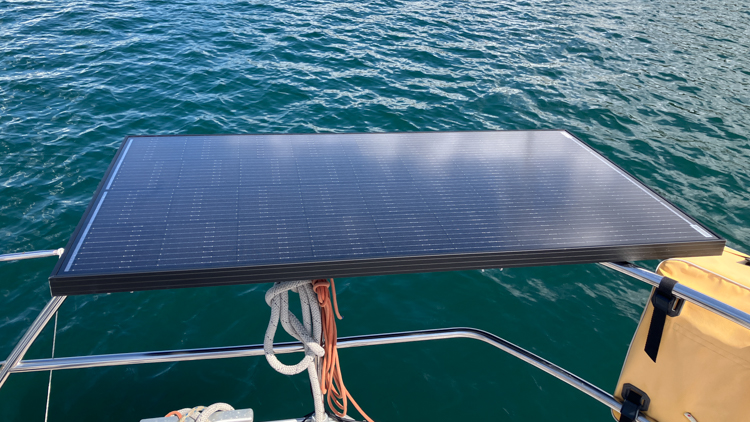
Vestlandskyss can generate a lot of electricity. She has three fixed solar panels, a tow-generator when sailing, and an upgraded engine alternator when motoring. Despite that, it was clear that the house batteries weren’t getting as much charge as we would expect, while the yacht was bobbing unattended on her mooring.

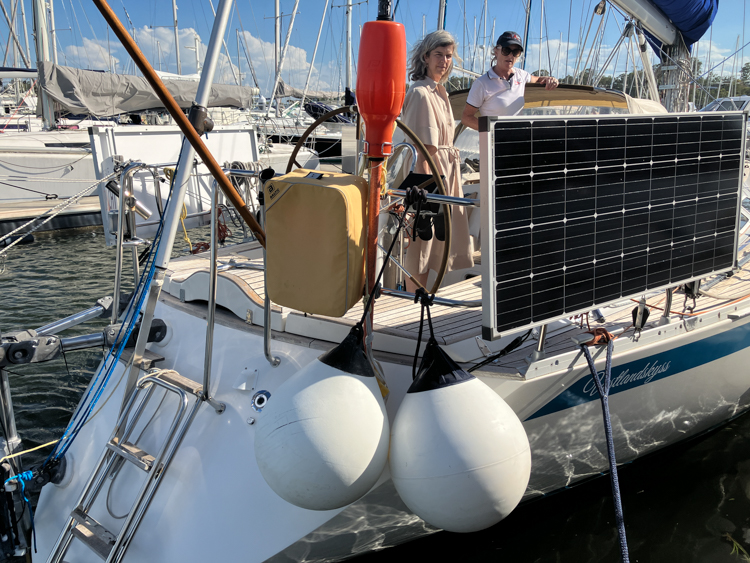
Of the solar panels, one is a flexible on the bimini hood that I have wired purely as a top-up for the cranking battery. We have some additional ‘briefcase style’ panels that can be mounted on deck at anchor, but most of the power generation is by two solid panels on either side of the cockpit. These can lie flat against the stanchions, but are swivelled out to face the sun when in use.
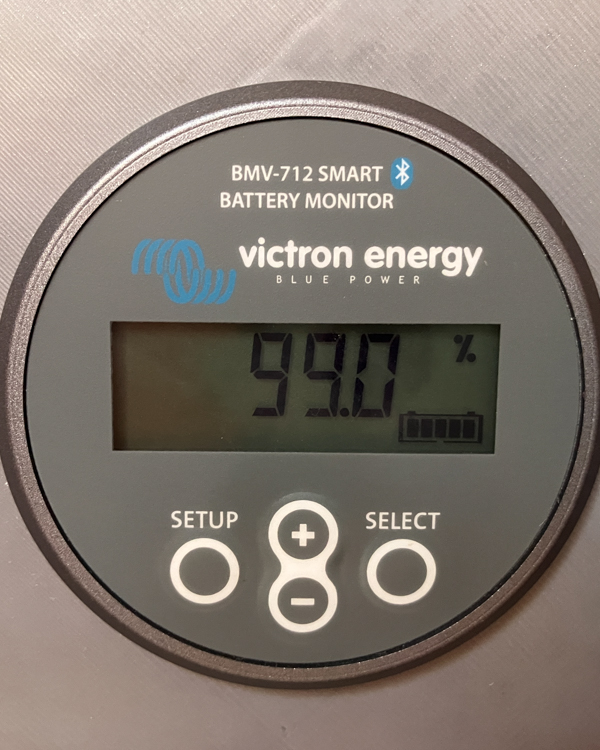
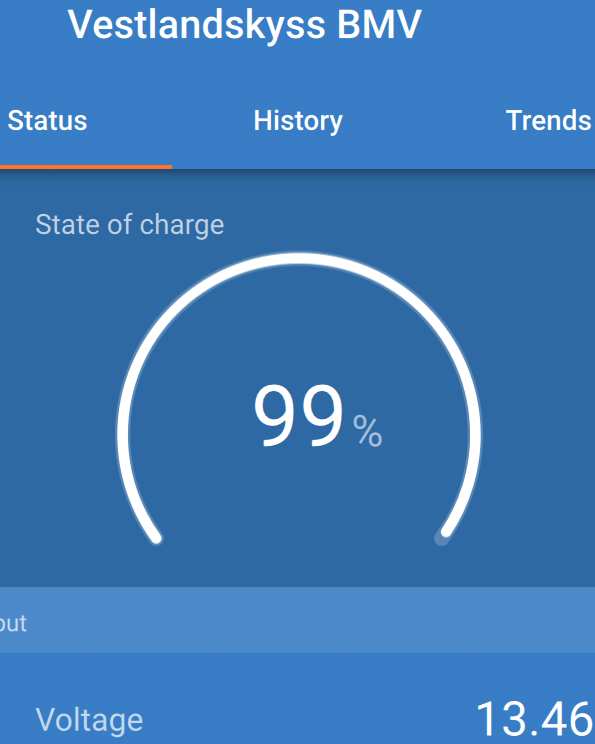
Each of our solar panels runs through one of three Victron MPPT controllers, and the total state of the system is aggregated and output onto a display. Every morning, when I get up to put on the coffee, one of my first checks is on the state of the batteries. Usually they are showing less than 100% charge because there are systems, such as the fridge and masthead lights, that run overnight, but in addition the MPPT controller calculates in real time the current going into and out of the house batteries.

On this particular morning, the sun was shining but there was no sign of any recharging. I checked the output from the controller, and there was nothing. I checked the joined output from the two cockpit panels, and again there was nothing.

Since both panels appeared to have failed at once – a very unlikely coincidence -I connected one of our spare briefcase panels in to the circuit, and the controller started up and behaved normally. The controller was fine. How could both cockpit panels have failed simultaneously?

I wanted to have a look at the connector box on the port side panel, but unfortunately it was occluded by the mounting rail, so I had to remove the rails and dismount the panel. This was a nerve-wracking task, because the mounting rails are comprised of a number of small fiddly pieces, and if I dropped one, it would fall irretrievably into the ocean. As it was, I successfully retained all the clamp parts, but lost a screwdriver overboard.
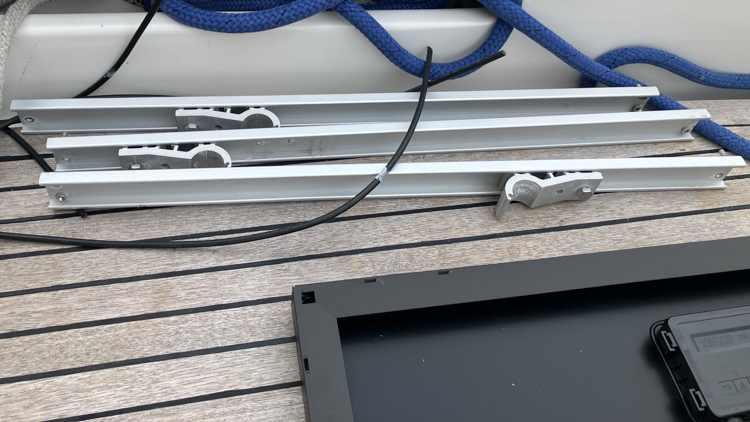
Once dismounted, I opened the connector box expecting to find some signs of, I don’t know, heat stress or rust or lightning strike, but there was nothing interesting to see at all. There were just a couple of diodes which tested out just fine, and some nice clean soldering.

The sun was shining, and the remaining starboard panel should have been generating oodles of power. I couldn’t get to the connector box, again because of the mounting rails, so I measured the voltage at the untidy nest of MC4 connectors in the lazarette. Still nothing.
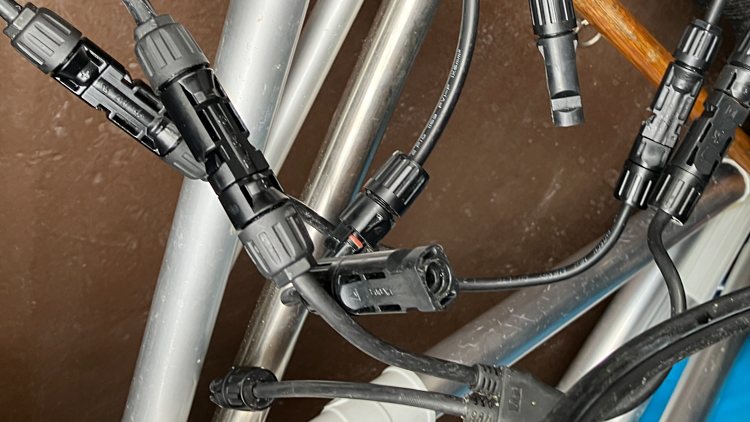
I do dislike MC4 connectors. They have become the world standard for solar arrays both on land and at sea. They are supposed to be (a) weather resistant, and (b) secure but easy to unplug. In my experience, they are neither. I don’t know which small child’s fingers were used as a model by the designer, but even my slender fingers are far too big to work the spring release. When I work with MC4s, I usually end up bleeding.
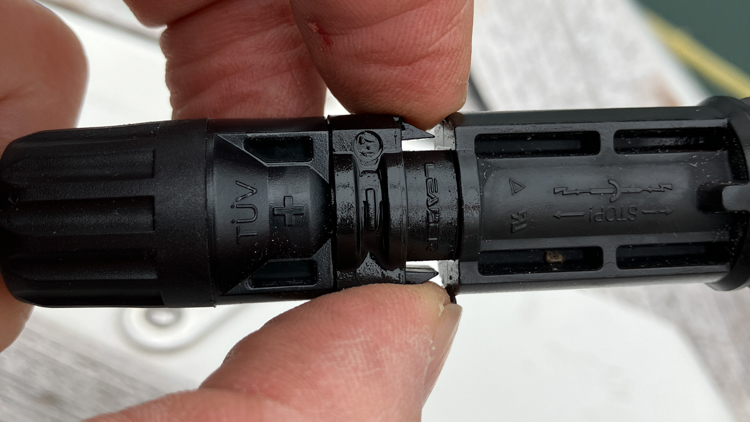
It wasn’t until I had dismounted the starboard panel that I discovered at least part of the problem. Salt water had got into one of the starboard MC4s where it crossed from the panel to the deck gland, and corrosion had been slowly rotting its way along the cables. The starboard panel was most likely still working, but the current wasn’t getting out through the corroded connectors.
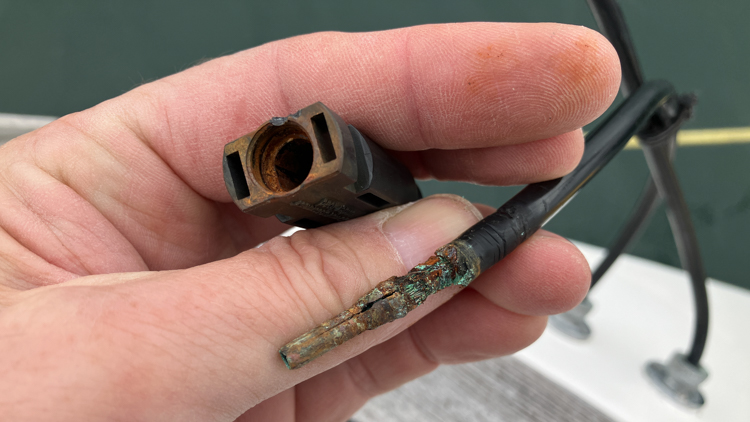
For some time, it seemed, we had only been operating on the port panel, and now this too had failed.

There’s nothing quite like salt water creeping along a copper wire, it is amazing to behold. I chased the rot along the cable for several metres, and then chopped out an additional metre for good measure. Thankfully there is a fair bit of spare cable aboard, and a number of unused MC4 connectors, to make good the lost sections.

Looking online for new solar panels, I could buy something the same physical size but with a modern, higher wattage (for a price!), or I could stick with 120 watts but with upgraded efficiency. These latter were only $200 per panel from Alvolta, delivered to the marina, so the deal was done.

Peter from the marina helped me to get the new panels out to the mooring in his tinny, and then it took a bit of juggling to fit the unwieldy great things into place.
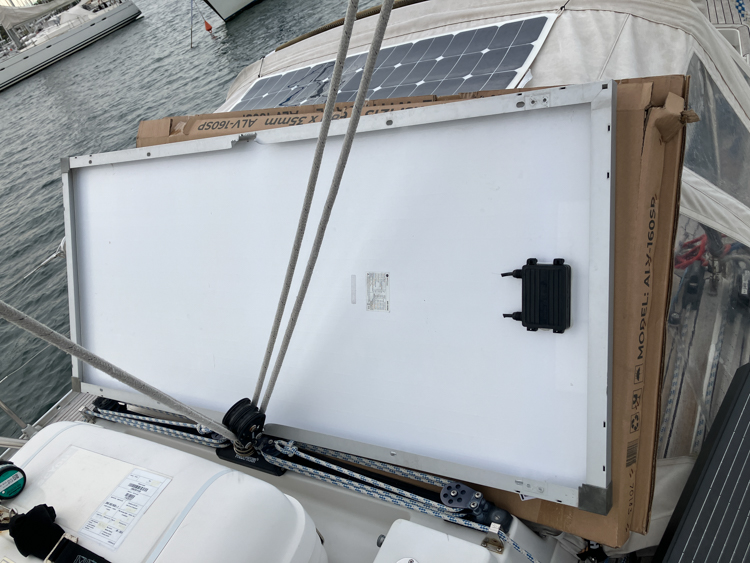
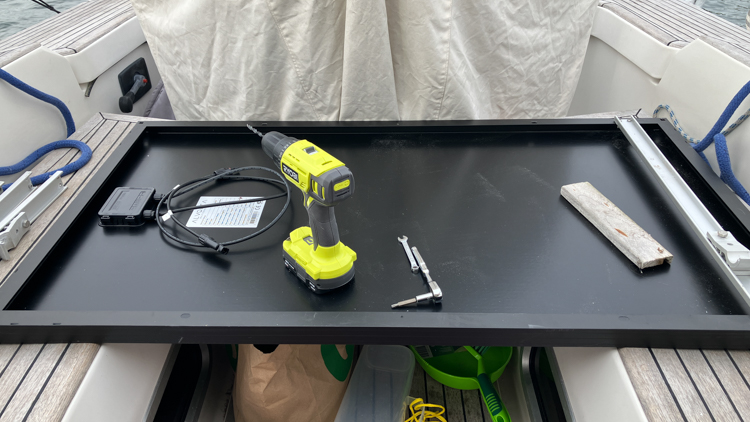
Thankfully, the new solar panels were several kilos lighter than the old ones, but there was still a heart-in-mouth moment where each one was balanced on the rail while I tried to secure the five loose and irreplaceable parts of each clamp mechanism above the unforgiving deep.

But then the job was done, and the sun came out.
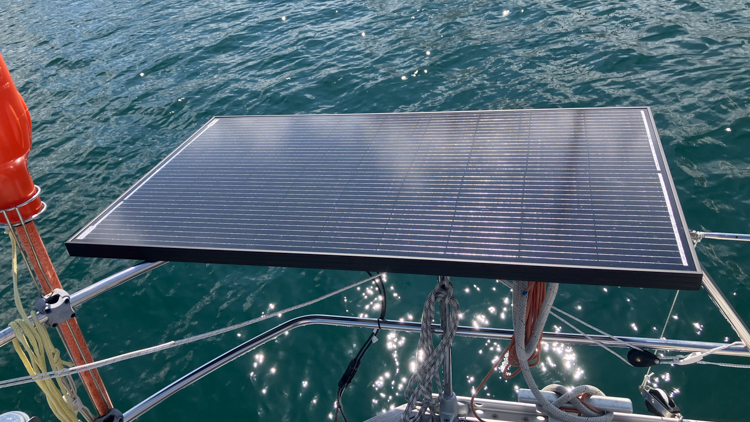
The batteries charged right up.
It was time to go sailing…

Autralian Yacht Registration

Now that we had purchased a foreign-registered yacht, we needed to organise her registration as an Australian vessel. The physical ship had been properly imported into Australia by the previous owners, but that is simply a Customs tax-generating exercise for importing a high-value asset. As a yacht, she was still officially registered in Norway.

Ship registration is linked to your MMSI which is the fundamental code that underlies much of the electronic safety gear, such as the VHF radio and the AIS signature. Without a valid MMSI, the equipment simply won’t work. In addition, if any of the emergency services aboard were to be activated, the distress call would carry a Norway prefix and – in theory at least – the Norwegian authorities and previous owners would be alerted.

We had agreed with the previous owner that they would not de-register from the Norwegian Registry until we had arranged a long-term anchorage, because I was concerned that our radio might stop working on the way down the coast from Queensland if the MMSI was removed. I suspect that I was overthinking it, but did not want to take the risk.

On arrival in Pittwater, New South Wales, we arranged a medium-term mooring because we needed to focus on non-sailing life for a few months. Vestlandskyss was going to be stationary for a while, so I applied for both Tasmanian State registration, and Australian national registration.

Tasmanian State Registration

State registration is a bit like a car registration, in that you get a licence number and pay a fee each year which goes toward maintaining public boat ramps and moorings and the like. You should really have State registration for the State that you are operating in… which had been Queensland… and was currently New South Wales… and would ultimately be Tasmania. In any event, the Tasmanian authorities were happy to give us our papers as soon as she had been de-registered from Norway and we could prove that we lived in Tasmania, something that I was able to do because we already have a Tasmanian registered mooring at the bottom of our property.

Australian maritime registration

That was all very well, and at least we had fulfilled the minimum requirements for an Australian vessel. What we really wanted, though, was our national registration with AMSA, the Australian Maritime Safety Authority. This would give us the right to fly the Australian flag and to specify our home port (Hobart) on the transom. Without it, we can’t realistically leave Australian territorial waters, because if we arrived in another country, we would be refused permission to land.

The AMSA registration paperwork is detailed, and most of the information is mandatory, even though much of it is geared to fishing vessels and cargo ships. Vestlandskyss is 26 years old, was built in Sweden and has had three Norwegian owners. We needed to be able to prove a continuous line of ownership going back to the building yard.

We also had to provide some quite abstruse measurements. Most of us know our length and beam and depth, but how many know the precise distance from the keel bolts to the underside of the deck? Luckily, Vestlandskyss was up on the hard at Bayview Slipway and they were able to measure it for us.

We also needed to get legally witnessed statutory declarations for this and that, which we submitted and then had to re-do because AMSA weren’t happy with some of the details.

They also required a certificate of de-registration from Norway, written in English. I contacted the previous owner and he contacted the Norwegian Registry who forwarded him an email saying that the job was done. No, not sufficient for AMSA. I then paid a fairly hefty fee and received a certificate saying that indeed and officially the job had been done… thankfully, a bilingual certificate, otherwise we would have had to get it translated.

And so it came to pass that AMSA considered our vessel worthy of flying the flag.

…but only if we complied with the Marking Note. This specifies that the registration number needs to be cut to a depth of 3mm, in numbers 100mm high, in a permanent structural cross-member below deck level.

In common with most private yachts, Vestlandskyss is made of glass-reinforced plastic. Cutting letters into a structural cross-member would negate the whole point of having a structural cross-member. There are special arrangements allowed for GRP vessels; for instance, we could epoxy a plastic sign with the required lettering. I contacted the local sign-maker, and they told me that for the lettering that AMSA wanted in the size that they wanted, the sign would be 1.5 metres wide, which was not only wider than any vertical surface on my boat, but wider than their largest available manufacturing jig.

I pondered the reason behind the requirement. Presumably, AMSA want to be able to identify the boat if she is found after years at the bottom of the sea, or if somebody has stolen her and given her a new identity. There’s actually only one visible structural crossmember on Vestlandskyss, which is abaft the anchor locker and under the forward berth. It already displayed the Scandinavian registration number in characters 3mm deep, but the builders had had the advantage of making them part of the mould during construction.

I purchased some 3mm thick stainless steel numerals, with the intention of screwing them into the mahogany panel above the original registration number. Unfortunately, I found that the panel is only a few millimetres thick and backed by a moulded structural wall to the anchor locker, so the screws would need to go into the bulkhead itself, and I sure as heck wasn’t going to drill any holes in it.

I went with Plan B, which was to epoxy the stainless steel numerals to the bulkhead below the existing registration.

I also spent a happy few hours in the dinghy, marking the name and home port on the transom.

I reckon we’re legal. Good to go.

Maintenance and Pleasure

Replacing stuff

We’d noticed that the cranking battery wasn’t charged by any of the solar arrays, and tended to very slowly lose power over long periods without the engine running. Since we have three solar circuits, I rewired the smallest one (a flexible panel on top of the bimini) to keep the cranking battery up to scratch.

We’d been having some problems with the head, an original equipment Raritan with parts only available from America. I’d ordered a couple of repair kits to be sent to the Anchorage marina at Nelson Bay, and so one starry night Brendon and I sat down and rebuilt it. Unlike some other toilets that I’ve worked on, this one is really simple and all the parts can be disassembled and examined on a work table, rather than from a prone position on the bathroom floor. We soon had it running again.

We also replaced the third reefing line, which was far too short so that the end disappeared up the mast when the main was fully hoisted. Sometimes it got stuck on the way up, which made things difficult. We replaced the line with one of suitable length from the vast store under the forepeak, and then used the old line, which was still in good condition, to replace the preventer which was badly frayed.

Sailing for fun

We’d spent a lot of time on passage and fixing things, so it was nice to do nothing more than go for a pleasant sail in Pittwater with friends. The weather was nice and the wind was gusty. We dropped anchor for lunch in Little Pittwater, watching all the other yachts race for home ahead of the coming wind change, and then beat home under staysail and reefed main, exchanging tacks with another cruising boat all the way back to the marina. Maintaining a cruising yacht may appear to be a lot of work, but when it’s all going well, it is just magic.

Up on the hard

Speaking of maintenance…

Personal and family commitments meant that we would be leaving Vestlandskyss to herself for a few months, so I thought that I would get some professionals to have a look at a few things while we were away. I was a bit concerned by some of the work that had been done by a workshop in Panama for the previous owners. One of their jobs had been to replace the D1 stays, which subsequently broke on passage across the Pacific. We had spoken to the previous owner’s rigger in Queensland and he told us that the wrong connecting parts had been fitted, which wore away the stays. He had just completed the repair when we first arrived to inspect the boat.

The Panamanian yard had also applied antifoul, and it was immediately clear to all of us when she came out of the water for survey that they had done a shoddy job, with parts of the naked hull showing through at the bow.

The last set of receipts from Panama also showed a full service of the engine, and I was beginning to feel suspicious about that, if only because the boss attaching the propeller to the saildrive had rather too much play in it.

I engaged Mark at Bayview Slipway to lift her out of the water and have a look. Mark was amazing, and kept me informed every step of the way, including daily photos of the work that they were doing. They quickly discovered that the reason for the loose prop was that the retaining nut inside the sail drive was only hand-tight, which was alarming but at least an easy fix. The mechanic also serviced the engine and declared that it was now in good order.

Bayview Slipway then stripped off what was left of the antifoul and put on a new base layer and three good coats, plus prop-speed treatment on the sail drive.

I returned to the boat and found everything spotless. What a great business. Thank you, Bayview Slipway.

South to Pittwater

I caught a plane to Newcastle to meet Brendon who had volunteered to help me sail Vestlandskyss from Nelson Bay down to Pittwater, just north of Sydney in New South Wales. My flight was supposed to land in the afternoon, with ample time to buy groceries on the way to the boat, but there was a fault in the plane’s trim circuit causing us to divert to Sydney to get it repaired, where we hit a bird on the way down and so had to switch planes. Thankfully Brendon had been driving around buying food in Newcastle, so by the time I eventually emerged from the airport, we could go straight to the marina.

The forecast was bad with a possible brief weather window at two o’clock the following morning, but when we arrived at the boat at 8 pm it was calm and quiet. We did some checks, ate a hasty dinner, and were on the water by 10 pm.

Rounding the Port Stephens light, motoring at six knots, we pointed the nose at Pittwater. The weather was calm and still, with about a metre of sloshy swell under a clear starlit sky, sporadically illuminated by electric storms. The Queen Elizabeth passed in the night, looking very impressive.

The wind picked up but was precisely on the nose and not much use for sailing. We were out of the Eastern Australian Current now, and missed its boost. On the way down from Queensland we could motor 6 knots at 2000 rpm, we now had to keep to 2800 to maintain the same speed.

We messed around a bit with different sail plans in the night, but it was simplest to just keep on under power, even though we were nervous about running out of fuel again. I turned on the water maker and it sprayed seawater all over the cabin until I realised that the fridge mechanic must have knocked the bleed valve when he was working on the compressor. I closed the valve and we were all good, and as a bonus, the fridge was still working.

We arrived in Pittwater in the early afternoon, and Peter at Gibson Marina was there to welcome us home to our swing mooring. Bronwyn and I had lived there until 2009 aboard our first yacht Pindimara, and it was great to be back in familiar waters. Thanks, Brendon, for being a magnificent crew.